sábado, 5 de agosto de 2023

WHEN THE ZC1000 WAS JUST A DREAM OF SHIGEO MIZUKAWA...

When the best movie camera, the never sufficiently praised ZC1000, was still in the project phase on Shigeo Mizukawa's desk, already in March 1972 it caught the attention of Peter Dean, from the British magazine FILM MAKING, who wrote (sic):

Cover of March 1972 issue

Zooming in on the hardware scene, we come up with an interesting camera that Fuji brought out in Japan as part of the Single-8 system. It looks as though somebody has been carefully studying the Beaulieu 4008 ZM because they have produced --on paper at least -- the latter´s spitting image. The new Fuji Single-8 8Z 1000 (even the name sounds similar) will accept interchangeable lenses from 16 mm cameras in standar C-mount, has a mirror shutter, and pulse outlet for syncronised sound. One intriguing feature which I can´t wait to see is said to be an interchangeable reflex viewfinder. Now that´s something the Beaulieu hasn´t got (or any other 8 mm camere for that question), although the Beaulieu does go some way towards it by having a ground glass focusing screen which you can switch in or out of the finder. And, of course, the Fuji offers all the well-known advangages of the Single-8 cartridge: accurate film transport, ability fo reverse any amount of film at any stage of filming, precission pressure plate. Final Fuji trump card is ther new Super 10x zoom, from 8 to 80 mm (...) 

Part of the text of the article

Anyway, I believe Fuji have wisely set out to capture some of the professional market with their new model? It does seem more logical to use Single-8 than Super-8 professionally. If only the could  (a) make an even thinner base and double the running time of the cartridge; (b) bring out a fast colour film, and (c) call that colour film Kodachrome, all might be swept before them.

Ignacio interview to Shigeo Mizukawa for a British and a German magazines

  • IMPORTANT NOTICE FOR THOSE FILMMAKERS WHO WISH TO INCORPORATE SUPER-8 INTO THEIR PROFESSIONAL OFFER:

For those readers in the professional field who believe it is convenient to offer Super-8 in their service portfolio, I always recommend Pro 8mm, the same provider used by Steven Spielberg, Spike Lee or J.J. Abrams.

My recommendation is proven: it certainly makes me proud to work with Phil and Rhonda Vigeant, whose efforts on Super-8 have been recognized by the ASC.

At Pro 8 mm they serve in Spanish and English, in the following link, and shipping to Europe takes only 3 days!

The complete catalog of products and services can be seen at the following link:

PRO 8MM


miércoles, 2 de agosto de 2023

A CRAZY NEW PROJECT IN STOP MOTION... AND SUPER-8!!!

 Animation in stop motion is considered crazy by many. Personally, I consider it the most excellent of the animation arts, which implies that the animator demonstrates his good work in various disciplines of cinematographic art. In order for this art to be even purer, it should not be prostituted by means of digital recordings, but rather it must be made with motion picture film. And if, as a cinematographic gauge, we choose Super-8 and reversal film, then this sublime art becomes... a madness. 

We are here for this, to carry out cinematographic feats. Álex López adapted the Bolex single frame filming device for use with the ZC1000N (for Super-8 film manually reloaded in Single-8 cartridges). Of course, there are more compact single-frame controler units but part of the craze is using classic elements like this Bolex control device. Why reversal and non-negative film, which admits corrections in post-production? Soon, we will continue reporting.


  • IMPORTANT NOTICE FOR THOSE FILMMAKERS WHO WISH TO INCORPORATE SUPER-8 INTO THEIR PROFESSIONAL OFFER:

For those readers in the professional field who believe it is convenient to offer Super-8 in their service portfolio, I always recommend Pro 8mm, the same provider used by Steven Spielberg, Spike Lee or J.J. Abrams.

My recommendation is proven: it certainly makes me proud to work with Phil and Rhonda Vigeant, whose efforts on Super-8 have been recognized by the ASC.

At Pro 8 mm they serve in Spanish and English, in the following link, and shipping to Europe takes only 3 days!

The complete catalog of products and services can be seen at the following link:

PRO 8MM

jueves, 27 de julio de 2023

OPPENHEIMER: EUMIG E.C.S. TYPE SPLICES FOR IMAX 70 MM 15 P. FILM PRINTS

The craziest splicing system for Super-8 film could only have emerged in the late sixties in the fiendishly of the wizards of Wien: the Eumig Chemo Splicer. I bought my ECS splicer when I was twelve years old but I never liked the system, until a few years ago! Now I use it when I want to make a slightly special transition between two sequences


70mm 15perf. splices type Eumig ECS, in zig zag

A splicer like this could only have been invented in the 1960s, sprung from the diabolical mind of a Teutonic scientist from Austria. In his day, as a child, the Eumig Chemo Splicer splicer cost a fortune (5,500 pesetas in 1972), and  me, of course, was not at all happy with zig-zag sawtooth splice).

However, currently, with vintage in full swing, these crazy zig zag splices, from the mythical Eumig (in those times the most important company in Austria), are a reflection of an era, so I try to do some into almost all my documentaries, as a nod to all of us who grew up with the super-8 and knowing that they will go unnoticed by the vast majority of viewers. After making the ECS zig zag splice, I reinforce it with another invisible one from Fujifilm.

It came as a surprise to me to discover that this splicing system is the one chosen for 70mm 15-perforation film. Eumig technicians wrote in the 1960s that the zig-zag splice increases the contact between both ends of the film. This is very important on 70mm 15-perforation film, and the splice is masked by the projector gate. Also, as my friend Gordon McLeod told me, zig zag splices prevents the splice from hinging or folding as it passes through the rolling loop. A lot of projectionists use blooping ink to hide the splice.  After all, the Eumig scientists may not have been so far off the mark!   (Note, with 70 mm-15 perforations films tape splices need to be retaped every 200 passes)


viernes, 21 de julio de 2023

THE FEIJOO EXPERIMENT

This evening, at the rally to close the campaign of the future president of Spain, Alberto Núñez Feijóo (who was, always by absolute majority, president of Galicia), I will carry out an experiment. With the leftover tails of the rolls from my documentary "Perfect Antarctic Madness", I prepared a spliced film in a Single-8 cartridge wit with Fuji. We'll see if the film with splices doesn't get stuck while filming and if they hold up to the developing chemicals! 

Another experiment is the camera itself: a Lilliputian P2, designed by my friend Shigeo Mizukawa, modified with the following improvements by algo my good friend Mateu Bauzá: 1) shutter reduced from 220 to 150 degrees; 2) remote control; 3) Iscorama anamorphic lens. It's not a lot of footage, about two minutes at 18 f.p.s., but enough for my experiment


miércoles, 19 de julio de 2023

¿UNA EXPOSICIÓN PARA "PERFECTA LOCURA ANTÁRTICA"?

Como ya saben los lectores, en mi conferencia en Nueva Zelanda, antes de emprender la expedición de mes y medio a la Antártida, llamó mas la atención la forma en que iba a filmar y fotografiar mi trabajo, con película cortada y recargada artesanalmente, que no mi cruzada sobre el calentamiento global y la contaminación, de forma que decidí reorientar la filmación e incluso cambiar el título del documental por "Perfecta Locura Antártica" en lugar de "Alén da fin do mundo" (en gallego, "Más allá del fin del mundo").

Todavía conservo el tebeo que compré con 8 o 9 años con la geste de Shackleton: ¿quién me iba a decir que iba a estar en su cama en la cabaña de la expedición Nimrod, a 77º30.4´S?

Y es que es una suprema locura filmar como lo hice: la película fresca que, gratuitamente,  me suministró el vicepresidente de Kodak fue, por un lado, en 16 mm pero con perforaciones tipo S, que tuve, en cuarto oscuro, que cortar a la mitad de su ancho en tiras de diez metros, e introducir en cartuchos de Single-8 (un minuto y medio de filmación cada uno); por otro lado, la que Kodak me mandó en cartuchos de Súper-8, tuve que extraer, de cada uno de ellos, doce metros, aproximadamente, para recargar cargadores de Single-8, también en cuarto obscuro. Una labor artesanal de alta precisión, en que son muchas las cosas que podrían haber salido mal: veladuras, pelos, atascos... sin solución posible en la Antártida,  pues nada se ve hasta después del revelado. Luchando hasta con los rayos X a la vuelta, si todo resultó perfecto, fue sin duda gracias a la vieira del peregrino de Santiago de Sargadelos bendecida, para la ocasión, por el Padre D. Manuel, a los mismos pies de la milenaria talla de la virgen del Santuario de Pastoriza, la misma ante la cual Requiario hizo de Galicia el primer reino cristiano del mundo reconocido por Roma.

Unas pocas que seleccioné asombran en la sala Nelson

Filmar con cartuchos de Single-8 me permitió usar mi cámara favorita con la que filmo desde 1979, la nunca suficientemente ponderada ZC1000N, cuyo diseñador, Shigeo Mizukawa, no sólo fue siguiendo la aventura, sino que me regaló varias cartuchos de Fujichrome, del último lote fabricado por Fujifilm hace unos once o doce años. Adicionalmente al material sensible mayoritario de Kodak y los metros de Fujichrome, cargué una poca película Svema, caducada con la caída del comunismo, como homenaje a Ucrania. El cargamento de película virgen, a fin de evitar el escáner CT de Dubai, que vela la película con sólo un pase, lo tuve que enviar por DHL a la Sociedad Fotográfica de Invercargill, en Nueva Zelanda, donde dí la conferencia (PULSE AQUÍ PARA MAS INFORMACIÓN). 

La vieira del peregrino Sargadelos, bendecida por el padre D. Manuel a los pies de la talla milenaria del Santuario de Pastoriza, en La Coruña, me protegió todo el periplo.

Eran tantas las cosas que podrían salir mal, incluso con el propio revelado, parcialmente artesanal, ¡y , sin embargo!, fruto del oficio y saber hacer, ¡el esfuerzo ciclópeo mereció la pena!, pues puedo aprovechar prácticamente la integridad del metraje, ¡que agoté! ¡Si Shackleton estuvo en la Antártida escaso de comida, yo de película!, siguiendo, además, su espíritu de trabajo, esto es, cargando sin ayuda con todo el equipo, a veces a menos de -30 grados Celsius, como en McMurdo Sund, con el ímprobo trabajo de cambiar los rollos ¡cada minuto y medio!, tras despojarme de guantes, etc, bajo el frío atroz, incluso la nieve, y tras limpiar siempre el espacio entre presor y ventanilla (¡un pelo micrométrico puede arruinar metraje irrepetible!, y es algo que no se ve hasta después de revelar)

Me imagino las Instax en paneles, rodeados con los equipamientos usados y proyecciones fílmicas en bucle

También disparé muchas diapositivas Kodak Ektachrome, alguna Fujichrome Velvia (reveladas por Interphoto) y, lo mas interesante, empleé una cámara InstantKon RF70 para todas las fotografías instantáneas tipo Polaroid del tipo Fujifilm Instax Wide (elegí este sistema, y no el de Kodak, pues es íntegramente mecánico-químico). Huelga aclarar que las fotografías intantáneas Fujifilm Instax están de moda entre los mas jóvenes, lo que captará sin duda a este sector de la audiencia poco propicio a acudir a exposiciones como la que estoy pergeñando. 

¡Panorama con película Instax de blanco y negro!

Lo bueno de la película Instax es que la pude comprar localmente en Invercargill (Nueva Zelanda). Esta semana, comencé a ordenar la ingente cantidad de fotografías instantáneas, etiquetando cada una de ellas, labor que hago en momentos libres y que me llevará un cierto tiempo. Al verlas el otro día, Nena exclamó: "¡Extraordinarias Polaroids, Ignacio! ¿Por qué no haces una exposición?"

Dándole vueltas a su sugerencia, la verdad es que es una idea seductora, dado que las instantáneas (y nunca mejor dicho), recogen los momentos cumbres de una expedición asombrosa, tanto en longitud (6.209 millas náuticas) como en aventuras y hechos históricos, de una forma que, aunque valorada por la juventud, contradice a lo habitual en los proyectos antárticos.

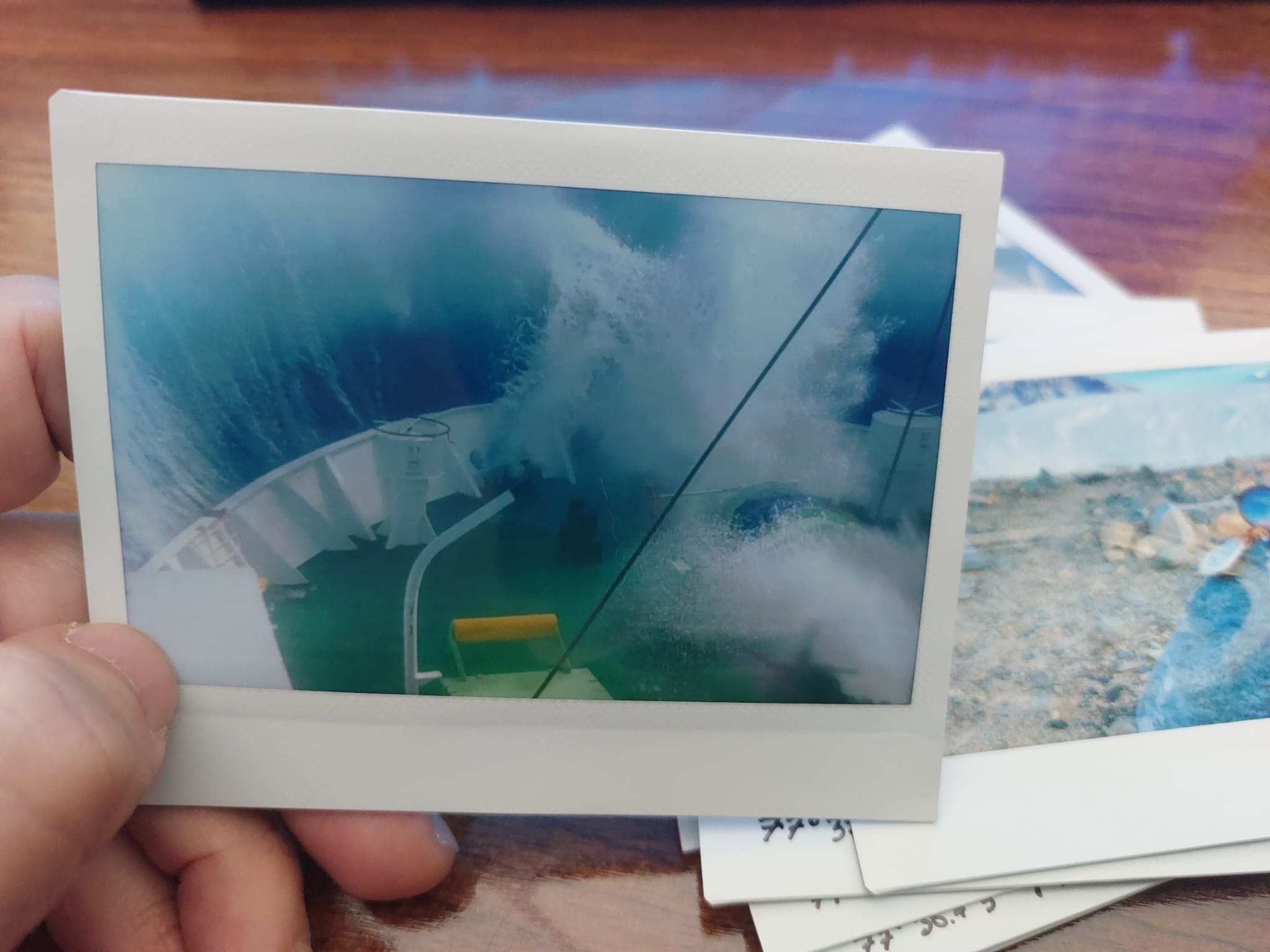
Cruzar los 50 aullantes, entre Nueva Zelanda y el Polo Sur Magnético, fue como estar dentro de una batidora

¿Cómo me imagino la exposición? Las fotografías Instax originales en murales en la pared, en un recorrido ordenado cronológicamente, con paneles explicativos de la aventura, los lugares históricos, la amenaza del calentamiento global, la geografía y la fauna.

Alternando con los paneles,  varios epidiascopios; uno de ellos, proyectará el mapa de la Antártida con la zona recorrida; y los demás diversos documentos interesantes relativos a la expedición, como la nota de confiscación de las pilas especiales en Nueva Zelanda. En las vitrinas, la cámara de cine empleada, las fotográficas (de carrete de 35 mm e Instax), objetivos, ropaje, los negativos de las películas de cine que estuvieron físicamente allí y muchas otras cosas,  como, por ejemplo,  las publicaciones sobre la Antártida, ¡incluyendo tebeos!,  que llevo acumulando desde hace algo mas de 50 años.  Un par de proyectores de diapositivas Kodak halógenos se situarán a lo largo del recorrido con proyección en continuo de una selección de diapositivas. Al fondo, un proyector de cine de 16 mm, cada hora, proyectará un extracto de la película de entre minuto y medio y tres. En un altar, con iluminación sobrenatural,  un gigantesco proyector de diapositivas de xenón Fumeo/Kodak (sólo hay dos en España, los dos en La Coruña) proyectaría una vez cada día un programa comentado de 72 diapositivas.  En una pequeña sala adyacente, para finalizar la jornada, la proyección cinematográfica, en 16 mm (paso cinematográfico que celebra este 2023 su centenario),  del largometraje "Spitsgergen, o Gardián do Ártico", ganador, entre otros galardones, del premio especial  XXV aniversario del Ourense Film Festival.

El proyecto llama la atención en los medios de comunicación
 Si en Nueva Zelanda el proyecto llamó la atención, ¿no podría ocurrir lo mismo en Galicia? El título para la exposición podría ser "Perfecta Locura Antártica... fílmica". Una aventura como esta, con estas técnicas, en el mundo, no se hizo jamás (ni siquiera en los tiempos del comandante Cousteau). Y una exposición así, en el siglo XXI, tampoco.

La noticia mas leída del trimestre


jueves, 13 de julio de 2023

FUMEO COMPLY ITS WARRANTY, 25 YEARS AFTER PURCHASE!, thanks to Marco Sonetti

In 1999 or 2000 I bought one of the last 9119 super-8 projectors that was manufactured at the Fumeo factory in Via Teocrito, 47, of Milano. When I opened it up, I was surprised that the amp was not like the other Fumeo projectors with the same amp I had, with brown circuit boards and printed circuit and components, but blue, non-transparent and unmarked. 

Brand new amplifier, just arrived from Marco Sonetti enormous warehouse in Italy

When asked about it, they said, "Don't worry, if you have a problem, don't fix it, we'll send you a new board." Well, 25 years later, this amplifier has a fault, and my friend José Manuel goes crazy trying to repair it, due to the lack of references on the board. 

Talking about the problem with Marco Sonetti, to my surprise he told me that he keeps the word that Fumeo gave me a quarter of a century ago: and he sent me a new amplifier, of the traditional type, totally free! (even the postage).  What a difference with the current brands of digital devices, which do not even serve you during the two years of mandatory warranty! 

Fumeo enthusiasts we are lucky that Marco Sonetti cares about keeping alive a brand that is, for many of us, a factory of dreams.

Both amplifiers


domingo, 9 de julio de 2023

FOUND A NEW ISSUE OF "PASO ESTRECHO"

"Paso Estrecho" was a Spanish magazine, edited by  Acción Súper-8 group from Barcelona, directed by Enrique López Manzano, dedicated to the smallest film formats than 35 mm, and especially to Super-8.

It began its journey as a fanzine, in 1977, although, over the years, it would grow and its last number was that of an authentic magazine, sold in kiosks, that the longed-for journalist from La Coruña  Manuel Martin Ferrand came to mention in his television program about new publicacions in Spain, at noon, in TVE.

Unfortunately, the video was just around the corner, which ended its short life, with heavy financial losses for the good old Enrique López Manzano, whom I dealt with personally when I was in the University in Barcelona, and with whom I am still in contact, through Facebook after all these decades.

I keep, bound, my collection of British and American magazines of the time, such as "Movie Maker", "Making Better Movies", "Film Making", Super 8 Filmmaker" and, of course, the Spanish  "Cinema 2002", in which I started writing when I was only 15 years old.

But the fanzine-type edited ones, such as "Paso Estrecho", since I couldn't bind them, I losted the issues over the years, and for this reason I am very happy every time I find an issue,  as happened today Sunday, in a flea market in my city (for only 1 €!) , which makes me especially excited.  I have already located 8 numbers of "Paso Estrecho" which, now, I keep duly filed in a folder, for future study and reference.

  • IMPORTANT NOTICE FOR THOSE FILMMAKERS WHO WISH TO INCORPORATE SUPER-8 INTO THEIR PROFESSIONAL OFFER:

For those readers in the professional field who believe it is convenient to offer Super-8 in their service portfolio, I always recommend Pro 8mm, the same provider used by Steven Spielberg, Spike Lee or J.J. Abrams.

My recommendation is proven: it certainly makes me proud to work with Phil and Rhonda Vigeant, whose efforts on Super-8 have been recognized by the ASC.

At Pro 8 mm they serve in Spanish and English, in the following link, and shipping to Europe takes only 3 days!

The complete catalog of products and services can be seen at the following link:

PRO 8MM