Mostrando entradas con la etiqueta Isco Cinelux f 1.1 11-30 mm. Mostrar todas las entradas

jueves, 28 de marzo de 2024

WHICH IS THE BEST ZOOM LENS FOR SUPER-8 PROJECTION?

When a Super-8 image comes from a very sharp film, if projected with professional projectors (CLICK HERE TO READ MORE), they will fill screens up to 6 or 7 meters wide with an atonishing quality, especially considering that the frame measures only 5.79 mm wide by 4:01 mm high.

On such large screens, to best projection quality, is required not only a powerful light source (xenon or HTI) , but also a first class steadiness and, above all, a good lens.

This test analizes the performance of the best lenses ever made for Super-8, using a Fumeo 9145 Xenon 500 Stereo projector with a micrometrical focussing system. 

Fumeo 9145 Xenon 500

Fumeo 9119

BEFORE THE TEST.

The Fumeo projectors have their lens holder valid for the European standard caliber, but they were mainly designed to be used with the Isco / Schneider range, so the lens holder had to be slightly modified by my friend José Manuel so that the micrometric focus had a range longer.


EUMIG SUPROVAR f 1.0 12-5-25 MM

This zoom lens, designed and built by "the Wizards of Vienna" (as Eumig was called by the beloved and late Ivan Watson,  columnist for the British magazine MOVIE MAKER), is absolutely historic: it´s the first f 1.0 zoom ever produced in the World, with a design finished in 1967, and which was available the following year.

Definition: very sharp image. 

Contrast: Good,  but not excellent due to the glass old one-layer coating system (despite being first class during 60s).

Colours: good. 

Construction: excellent. The best of all lenses, with an all-metal barrel that it´s easy to disassemble for service.


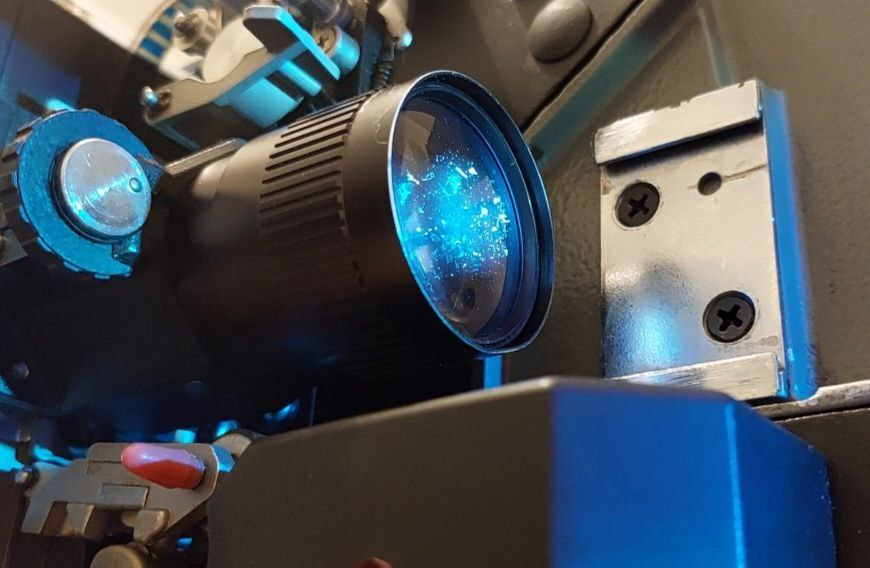
ISCO CINELUX f 1.1 11-30 MM

It´s considered the non plus ultra of zoom lenses manufactured in Europe, with an enormous focal range. It is the final version of the well-known Schneider design, manufactured with Schott glass and with a multicoated system improved. It was the verylast zoom lens available, on Isco's price list until the beginning of this century.

Definition: very sharp image, fully flat field of border to border (very important for anamorphic presentations)

Contrast: Excellent, the best of all, thanks to its latest generation multicoated glass.

Colors: good but with a duller tone than others.

Construction: so so only. The barrel is made of poor quality plastic. Part of the optical group is glued with balm and is difficult, if not impossible, to separate.  


MEOPTA CORRIGON f 1.1 12.5 - 25 MM

The quality of this lens is surprising, the best zoom lens produced behind the Iron Curtain. Nobody knows why it was done. This unit was given to me by my Galician friend Pichi Pedrosa. He found it some years ago in a photographic store in London, where the dealers were unaware of its use. This zoom lens is much longer than any other, so in the Fumeo, you have to put aside anamorphic to swing open the prime lens holder.

Definition: Very sharp picture. 

Contrast: Very good.  

Colours: Excellent (crisp and bright) 

Construction: excellent. With an all-metal barrel that it´s easy to disassemble for service.


FUJINON f 1.2 21.5 - 43 MM

This lens was originally intended for long distance projection or for use in telecine machines. Its only drawback is that, at a certain focal length, it does not focus if the screen is less than three meters away.

Definition: Sharp image. 

Contrast: Good.  

Colours: Good (slightly cold)

Construction: excellent. With an all-metal barrel that it´s easy to disassemble for service.


EUMIG SUPROGON F 1.2 12.5 --25 MM

Sold too as Bolex brand. It´s the cheapest and easiest lens to find but full of virtues: nothing but good can be written about it. It was manufactured in two versions: the latter with multi-coated lenses to improve contrast.

Definition: Sharp image. 

Contrast: Good.  

Colours: Good.

Construction: Plastic barrel but of high quality and easy to repair. 


KERN f 1.1 23MM

In the early 1970s, Ivan Watson rated it as the sharpest projection lens ever made. Projection picture with this non-zoom lens is very sharp, fully flat field from edge to edge, but it only has one layer of optical coating, as was normal in the late sixties, so the contrast is not as good as in more recent lenses. Su luminosidad es realmente f 1.0

Definition: Very sharp image, flat field.

Contrast: Good.  

Colours: Excellent

Construction: Metallic barrel, easy to repair.


VERDICT.

With the Fumeo 9145 xenon 500, for anamorphic projections, I will use the zoom lens that comes from the factory: the Isco Cinelux f 1.1 11-30 mm, for its great quality... as long as the lens lasts, because, sooner or later, its plastic barrel ends up breaking. For flat projections, I will use the Meopta Corrigon f 1.1 12.5-25:  it provides a very sharp image and the best colour.  

For purely visual beauty considerations, I will use the Eumig Suprovar f 1.0 18-28mm exclusively with the Fumeo 9119 projector: it is also a very sharp zoom lens and its aesthetics are very much in line with that of the projector, especially using the French Hypergonar anamorphic.


Important note: 
1) Excellent Fujinon f 1.0 14-28 mm and Canon f 1.0 17-28 zoom lenses don´t focus in this projector.  
2) There are three Elmo lenses, manufactured by Kowa, of very good quality: the called "pair" zooms, 1.0, 1.2 and 1.4 
They cannot be checked in this test because the diameter of the barrel is larger than the European one. The 1.0, while sharp, doesn't provide a flat edge-to-edge picture, something that the long-distance 1.2 and 1.4 do. In my opinion, Elmo f 1.2  25-50 mm is perhaps the sharpest zoom lens for Super-8


martes, 12 de enero de 2021

BRILLIANT EUROPEAN PROJECTION ZOOMS

European brands were the first to develop variable focal lenses --zooms- of high luminosity (f 1.1 and f 1.0) for the Super-8 format. From the outset, both Kodak (with the legendary Ektar f 1.0 28mm) and Fujifilm (with the highly sought Fujinon 25mm f 1.0) offered f 1.0 prime lenses, but it wasn't until Austrian Eumig introduced their Suprogon. f 1.0 that these high luminosities did not reach the zoom lenses (years before the Japanese did, with the Fujinon f 1.0 of 14-28 mm released in 1974).

EUMIG SUPROGON 1.0

Ivan Watson, in his Movie Maker column, was always a proponent of the Eumig Suprogon 1.0 18-28mm, designed in Switzerland and made in Austria. It is a highly sought after lens, although, in my opinion, the performance is far superior in others. 

THE KERN 1.1... REALLY A 1.0!

Kern built in Switzerland, exclusively for that madness that was the Paillard Bolex Multimatic projector, the fantastic f 1.1 17-34mm  zoom lens, really hard to find because it was never standard equipment, but optional. The image quality is incredible, with amazingly contrasting images, but unfortunately it is not compatible with any other projector, even from the brand itself. It comes in a European mount, yes, but not with the standard 32.5mm for super-8, but the 42.5 mm for 16mm!

An English friend of mine managed to adapt it to his Noris, after a major surgery. Subjecting this Swiss lens to rigorous analysis by Francis Williams, his conclusions were published in Movie Maker: it is actually a 1.0, which contrasts with the procedures of other manufacturers, who normally lie, and boast of a luminosity that they do not have.

THE LIGHT THAT CAME FROM BEHIND THE IRON CURTAIN: CORRIGON.

In the middle of the Cold War, behind the Iron Curtain, the only 1.1 variable focal lens is the very rare Meopta Vario Corrigon f 1.1 12.5 -25mm, made in a country that doesn't even exist anymore: Czechoslovakia. The definition is amazing.


SCHNEIDER AND ISCO: UNTIL THE END.

As an evolution of its accredited Schneider Xenovaron f 1.3 from 12 to 30 mm, the German brand introduced in 1975  the Schneider Xenovaron f 1.1. 11-30 mm  which, if it is a good unit (like those mounted on the Braun Visacustic 2000, where each lens was tested one by one, and the no perfect ones, were returned to the factory, where it was sent to other projector factories). Schneider's 1.1 is the target against which all others are judged.

The same optical design, f 1.1 11-30mm  was also produced near the end of the Super-8 as mass market as Isco Cinelux f 1.1 11-30 mm, the non plus ultra of European lens quality

  • Note: other European manufacturers also had produced other 1.1 zoom lenses, as Will Travenon, but with inferior quality and they play in other league.