Mostrando entradas con la etiqueta Fumeo 9119. Mostrar todas las entradas

martes, 3 de febrero de 2026

RESTAURACIÓN DE LA ZAPATA DE LOS RODILLOS DENTADOS DE UN FUMEO 9119 DE SÚPER-8 (2 de 2)

Tras la introducción de la entrada precedente, toca ahora aplicar la fórmula que le fue revelada a Álex por un ingeniero de nuestras Fuerzas Armadas que, en sus ratos libres, se dedica a restaurar aparatos militares obsoletos, en una mezcla de saber empírico, paciencia monástica y liturgia química que funciona sorprendentemente bien. Esta receta para el aluminio herido debe seguirse con exactitud casi bíblica.

Zapata sin restauración

EL BAÑO PURIFICADOR.

Las zapatas o presores de aluminio, una vez desmontadas del proyector de cine Fumeo 9119,  se sumergen en vinagre blanco no seis minutos, ni ocho, sino exactamente siete.
Ni uno más ni uno menos, pues la precisión es importante para atacar la oxidación del aluminio sin dañar la física de la pieza.
Siete minutos, siete, como los días de la Creación.
Tras ese tiempo, la superficie comienza a mostrar signos claros de que la costra de óxido ha sido debilitada.

Zapata casi restaurada

EL DESPRENDIMIENTO DEL PECADO.

Inmediatamente después, se procede al frotado con cepillo, agua y jabón de lavavajillas marca Mistol.
En este paso se eliminan los restos de óxido reblandecido por el vinagre, y la pieza empieza a revelar su auténtica naturaleza metálica bajo la pátina de abandono.

Zapata casi restaurada

LA TRIPLE LIJA (AL AGUA).

Seguidamente llega el trabajo de finura ucraniana: la lija con la zapata mojada, lo que se denomina “lija al agua”. En un primer paso se utiliza lija de grano 400 al agua para eliminar irregularidades profundas. En un segundo paso se emplea lija de grano 600 al agua para refinar la superficie. En el paso final, con lija de grano 1000 al agua, se borran los últimos rastros de arañazos visibles. Cada fase del lijado es un proceso lento, casi meditativo, en el que cada pasada devuelve al aluminio su dignidad original.

LAVADO Y SECADO.
A continuación, una nueva limpieza con agua y jabón, tras lo cual se seca cuidadosamente la zapata con un paño limpio.
En este punto, el presor ya no parece un resto arqueológico, sino que vuelve a revelarse como una auténtica pieza mecánica, incluso mejor que cuando salió de Via Teocrito, 47, en Milán.

Sidol: imprescindible

EL BRILLO FINAL.
Se aplica Aladdin (de Sidol) con algodón, no como quien pule una cacerola, sino como quien restaura un instrumento científico. Poco a poco aparece un brillo profundo, metálico y elegante, en el que el aluminio recupera su presencia.

Las dos zapatas ya instaladas
LA PROTECCIÓN.

Por último, se aplica una gotita de WD-40 con un paño limpio, no para engrasar, sino para proteger. Fumeo pintaba estos presores precisamente para proteger el aluminio: la pintura era la barrera contra la oxidación. Pero, como demuestra este caso, en ambientes con humedades superiores al 80 % durante más de treinta años, aquella protección no fue suficiente. En esta restauración en concreto, conscientemente, se ha decidido no repintarlos. La pintura original todavía se fabrica (disponemos de la referencia exacta), pero el acabado pulido del aluminio desnudo es tan bello que merece quedarse así. No es una traición al diseño original, sino una reinterpretación respetuosa.

Primera parte del artículo: CLIQUE AQUÍ PARA LEERLA


lunes, 2 de febrero de 2026

RESTAURACIÓN DE LA ZAPATA DE LOS RODILLOS DENTADOS DE UN FUMEO 9119 DE SÚPER-8 (1 de 2)

En los proyectores Fumeo de 16 mm, las zapatas (o presores) de los rodillos dentados, denominados guards en inglés,  fueron siempre un elemento casi filosófico: la propia fábrica los consideraba innecesarios y, por ello, los ofrecía como accesorio opcional (aunque todos mis modelos de xenón de 16 mm los incorporan).

Mis dedos señalan los dos presores o zapatas de cada rueda dentada en el Fumeo 9119, ya restaurado

En el caso concreto del Súper-8, Fumeo sí decidió montarlas siempre de origen. Ahora bien, su utilidad real es limitada: solo resultan verdaderamente necesarias cuando se proyecta en marcha atrás o cuando se trabaja con película muy contraída por el paso del tiempo o por malas condiciones de conservación. En proyección normal, con película en buen estado, suelo proyectar con las zapatas abiertas.

Estas zapatas están fabricadas en aluminio y protegidas por una capa de pintura. En el Fumeo 9119 que estamos restaurando (por puro placer mecánico, sin otra finalidad que devolverle su dignidad original), nos encontramos con un problema serio: los guards estaban en un estado lamentable, profundamente dañados por la oxidación del aluminio.

¡Nunca ví una zapata tan dañada!

No sabemos con certeza el origen del mal. Podría tratarse de una partida defectuosa de fundición (quizá el aluminio no alcanzó la temperatura adecuada en el proceso) o, más sencillamente, de décadas de conservación deficiente en un ambiente húmedo. El resultado, en cualquier caso, es claro: superficies rugosas, material debilitado y un aspecto infame, incompatible con una máquina concebida con la solidez industrial de Fumeo.

El objetivo es devolver estos presores o zapatas de aluminio a su estado original, tanto funcional como estético, y hacerlo además con un método reproducible, que pueda servir para futuras restauraciones. Para ello vamos a aplicar una fórmula que le pasó a Álex un ingeniero de nuestras Fuerzas Armadas, pensada precisamente para la recuperación de piezas de aluminio degradadas por oxidación.

No se trata solo de limpiar, sino de rescatar una pieza mecánica olvidada, respetando su geometría, su función y su espíritu original. Esta es, al fin y al cabo, nuestra filosofía al restaurar todo lo relacionado con el cine fotoquímico: no basta con que funcione, tiene que volver a ser lo que fue. Porque incluso las piezas que parecen prescindibles, como estos humildes presores de rodillos dentados, forman parte de una concepción industrial en la que nada se hacía al azar y todo estaba pensado para durar.

Vayan comprando vinagre blanco, papel de lija de grano 400, 600 y 1000, Aladdin y WD-40: serán los ingredientes necesarios para poner en práctica la valiosa información que se facilitará en la segunda parte de este artículo.

CONTINUACIÓN DE ESTA ENTRADA: PULSE AQUÍ PARA LEERLA

Restauración casi terminada


jueves, 28 de marzo de 2024

WHICH IS THE BEST ZOOM LENS FOR SUPER-8 PROJECTION?

When a Super-8 image comes from a very sharp film, if projected with professional projectors (CLICK HERE TO READ MORE), they will fill screens up to 6 or 7 meters wide with an atonishing quality, especially considering that the frame measures only 5.79 mm wide by 4:01 mm high.

On such large screens, to best projection quality, is required not only a powerful light source (xenon or HTI) , but also a first class steadiness and, above all, a good lens.

This test analizes the performance of the best lenses ever made for Super-8, using a Fumeo 9145 Xenon 500 Stereo projector with a micrometrical focussing system. 

Fumeo 9145 Xenon 500

Fumeo 9119

BEFORE THE TEST.

The Fumeo projectors have their lens holder valid for the European standard caliber, but they were mainly designed to be used with the Isco / Schneider range, so the lens holder had to be slightly modified by my friend José Manuel so that the micrometric focus had a range longer.


EUMIG SUPROVAR f 1.0 12-5-25 MM

This zoom lens, designed and built by "the Wizards of Vienna" (as Eumig was called by the beloved and late Ivan Watson,  columnist for the British magazine MOVIE MAKER), is absolutely historic: it´s the first f 1.0 zoom ever produced in the World, with a design finished in 1967, and which was available the following year.

Definition: very sharp image. 

Contrast: Good,  but not excellent due to the glass old one-layer coating system (despite being first class during 60s).

Colours: good. 

Construction: excellent. The best of all lenses, with an all-metal barrel that it´s easy to disassemble for service.


ISCO CINELUX f 1.1 11-30 MM

It´s considered the non plus ultra of zoom lenses manufactured in Europe, with an enormous focal range. It is the final version of the well-known Schneider design, manufactured with Schott glass and with a multicoated system improved. It was the verylast zoom lens available, on Isco's price list until the beginning of this century.

Definition: very sharp image, fully flat field of border to border (very important for anamorphic presentations)

Contrast: Excellent, the best of all, thanks to its latest generation multicoated glass.

Colors: good but with a duller tone than others.

Construction: so so only. The barrel is made of poor quality plastic. Part of the optical group is glued with balm and is difficult, if not impossible, to separate.  


MEOPTA CORRIGON f 1.1 12.5 - 25 MM

The quality of this lens is surprising, the best zoom lens produced behind the Iron Curtain. Nobody knows why it was done. This unit was given to me by my Galician friend Pichi Pedrosa. He found it some years ago in a photographic store in London, where the dealers were unaware of its use. This zoom lens is much longer than any other, so in the Fumeo, you have to put aside anamorphic to swing open the prime lens holder.

Definition: Very sharp picture. 

Contrast: Very good.  

Colours: Excellent (crisp and bright) 

Construction: excellent. With an all-metal barrel that it´s easy to disassemble for service.


FUJINON f 1.2 21.5 - 43 MM

This lens was originally intended for long distance projection or for use in telecine machines. Its only drawback is that, at a certain focal length, it does not focus if the screen is less than three meters away.

Definition: Sharp image. 

Contrast: Good.  

Colours: Good (slightly cold)

Construction: excellent. With an all-metal barrel that it´s easy to disassemble for service.


EUMIG SUPROGON F 1.2 12.5 --25 MM

Sold too as Bolex brand. It´s the cheapest and easiest lens to find but full of virtues: nothing but good can be written about it. It was manufactured in two versions: the latter with multi-coated lenses to improve contrast.

Definition: Sharp image. 

Contrast: Good.  

Colours: Good.

Construction: Plastic barrel but of high quality and easy to repair. 


KERN f 1.1 23MM

In the early 1970s, Ivan Watson rated it as the sharpest projection lens ever made. Projection picture with this non-zoom lens is very sharp, fully flat field from edge to edge, but it only has one layer of optical coating, as was normal in the late sixties, so the contrast is not as good as in more recent lenses. Su luminosidad es realmente f 1.0

Definition: Very sharp image, flat field.

Contrast: Good.  

Colours: Excellent

Construction: Metallic barrel, easy to repair.


VERDICT.

With the Fumeo 9145 xenon 500, for anamorphic projections, I will use the zoom lens that comes from the factory: the Isco Cinelux f 1.1 11-30 mm, for its great quality... as long as the lens lasts, because, sooner or later, its plastic barrel ends up breaking. For flat projections, I will use the Meopta Corrigon f 1.1 12.5-25:  it provides a very sharp image and the best colour.  

For purely visual beauty considerations, I will use the Eumig Suprovar f 1.0 18-28mm exclusively with the Fumeo 9119 projector: it is also a very sharp zoom lens and its aesthetics are very much in line with that of the projector, especially using the French Hypergonar anamorphic.


Important note: 
1) Excellent Fujinon f 1.0 14-28 mm and Canon f 1.0 17-28 zoom lenses don´t focus in this projector.  
2) There are three Elmo lenses, manufactured by Kowa, of very good quality: the called "pair" zooms, 1.0, 1.2 and 1.4 
They cannot be checked in this test because the diameter of the barrel is larger than the European one. The 1.0, while sharp, doesn't provide a flat edge-to-edge picture, something that the long-distance 1.2 and 1.4 do. In my opinion, Elmo f 1.2  25-50 mm is perhaps the sharpest zoom lens for Super-8


miércoles, 8 de junio de 2022

FUMEO 9119 ADAPTED FOR THE EUMIG SUPROVAR 1.0 ZOOM

The super-8 film gauge was born with high speed lenses, f 1.0, in both Kodak and Fuji projectors. But they were with fixed focal. The first f 1.0 zoom was European, from the legendary Austrian projector factory Eumig, the famous Suprovar f 1.0 18-28mm. Its quality was exceptional, considering that it was calculated with pen and paper: at that time there were no computers.

Over the years, the Suprovar 1.0 zoom would be outperformed by other varifocal f 1.0 lenses from other manufacturers, such as Canon, Fuji, Sankyo and, above all, Elmo (designed and manufactured by Kowa).

But the Suprovar f 1.0 18-28mm  holds a special place in the world of Super-8 film. For this reason, our friend Luigi Petrin has adapted a Fumeo 9119 (the version with micrometrical focusing) so that it can accept this historical zoom lens: Italian and Austrian technology, hand in hand!, in search of excellence for the Super-8


martes, 5 de enero de 2021

WHICH SUPER-8 PROJECTORS TO BUY? HIGH-END MACHINES (Part 9 of 10)

In this installment nine of a ten parts article originally published, in extended version by SilverGrain Classics magazine,  I write about projectors in the premium class category for the keen ciné enthusiast, as the Fujicascope SH30, Fujicascope SD25, the Bauer Studio range of projectors, the Elmo GS1200, the Beaulieu Studio, the Fumeo 9119 and the Braun Visacustic 2000.

Fujicascope SD25 Stereo Quartz

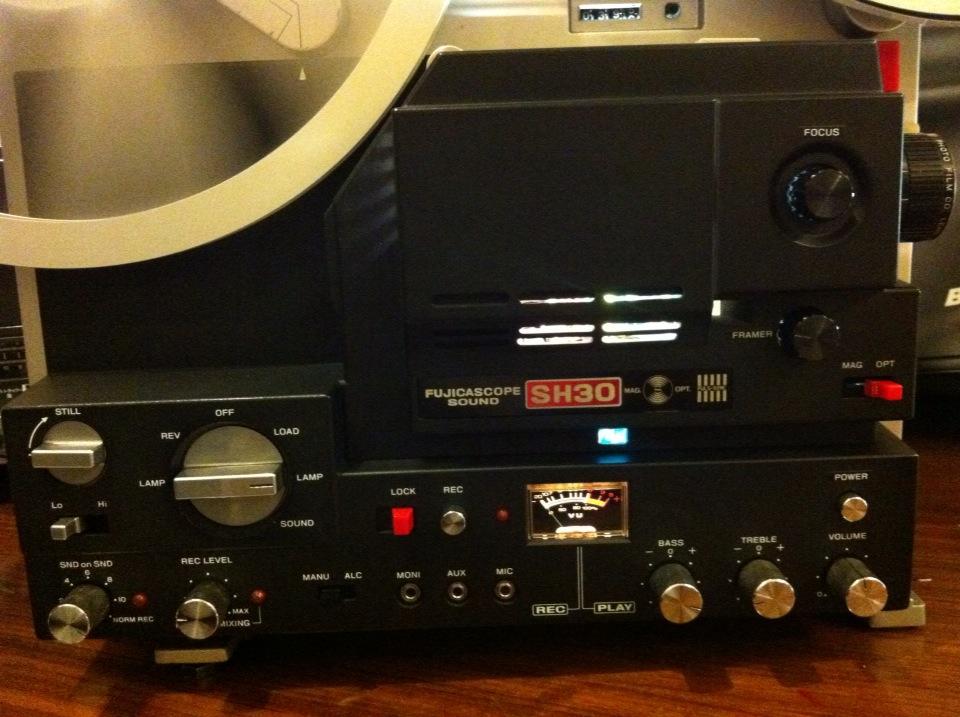
FUJICASCOPE SH30 and SD25. The Fujicascope SH30, introduced in 1975, was a projector ahead of its time, with a f1.0 14-28mm zoom lens, fine speed and a sophisticated electronic control (originally conceived to synchronize sound by electronic impulses or link two projectors for stereoscopy)

More complex electronically, and with stereo sound, is the Fujicascope SD25, with the same 1.0 lens and 360 meters reels capacity too, but a very useful speed control by quartz, microcomputer, and large digital frame reader. I use the Fujicascope SD25 to build the sound recordings in my movies. 

Fujicascope SH30

After the collapse of the Super-8 market, this model was sold at a fraction of its cost, in some markets,  as the Yelco 3600 (but with an inferior lens than the original Fujinon 1.0). Also interesting is its younger brother the Fujicascope SD20, with no microprocessor, but retaining the lens and quartz speed control. Quartz is essential when it comes to synchronizing with external devices such as a Blu Ray. In the Fujicascope SD25, being the filmmaker able to see the speed on the LED display, is possible to vary it at will when desired from 16 to 26 f.p.s. 

This 3 Fujicascope projectors use the 150 W lamp with good light output, because the fast pull-down of the claw. The excellent electronics giving good sound quality  with plenty of outlut power. 


The LED digital frame-counter is superb in the SD25, as also the microprocessor system for pre-programming. One strong point of this projectors are the magnetic head, of sendust type, able to last a lot of time! In facts, machines like this were used by Perry´s Movies, in London, to record the sound of commercial prints sold by this company. Further, this 3 Fujicascope sisters can play optical tracks, too.

A very clever design feature, on the Fujicascope SD25 Stereo Quartz (and SD20), for the independent filmmaker, is that all the sound inputs, which allow recording of complex tracks, are located on the front of the projector, and not on the back or the side.

Braun Visacustic 2000 with original Iscomorphot anamorphic

BRAUN VISACUSTIC 2000 DIGITAL. More than 40 years after its commercialization, the Braun Visacustic still attracts attention for its exterior design (which seduced Steve Jobs himself. He ordered two units of the 2000 Digital in Lee's Cameras, in 1983, which were personally delivered to him in his house in Belgravia by Martin Lee himself.  However, the best of Visacustic is inside:

1) Rear sprung pressure plate (in the lamp side), as in the Beaulieu (which allows project film with different thickness without the need to correct the focus) --more about this feature in installment 6 of this series--


2) Speeds of 16 2/3 and 25 f.p.s., in addition to the normal ones, as well as fine adjustment;

3) easy unthreading of a parcially projected film;

4) very fast pull down of the claw (for maximum light output of the 150 W lamp);
5) rounded edge projection frame;
6) swing open type lens holder; and
7) easy external electronic control, to enslave the machine with a Blu Ray reader or a quartz device.

The
 Braun Visacustic 2000 comes  with the famous Schneider f 1.1 11 - 30 mm. But few know that in the Braun company a female technique with eagle eyes (called Eva, perhaps?) tested the lenses individually, and the ones that did not meet the ideal characteristics were returned to the lens factory and perhaps sold to other makers: that's why all projections with a Visacustic 2000 look so sharp!


BEAULIEU STEREO STUDIO: A LIGHTHOUSE WITH A CHEAP LAMP.
The Beaulieu Stereo Studio halogen provides more light than the Elmo GS1200. How is it possible, if the Beaulieu use the inexpensive 150W lamp, instead of the expensive and hard to find 200W of the Elmo? One of the reasons is that the Beaulieu has a variable shutter, which allows the blades to be reduced from 3 to 2. 
But how does it get more light than the Fumeo 9119, which has a two-bladed shutter and the same expensive 200W ESC lamp of the Elmo GS1200?  

The explanation is its ultra-fast pull down in the Beaulieu, which allows each blade of the shutter to be reduced to just 40 degrees, instead of the Elmo's 60 degrees.
I love the Studio Stereo for syncing feature film audio in one go, from a digital source.


OTHER SPECIAL CHARACTERISTICS OF THE BEAULIEU STUDIO:
1) Rear sprung pressure in the side of the lamp: this allows to project films of different thicknesses without the need to correct the focus (for example, polyester with triacetate), with swing open type lens holder;
2) Micrometric focus: the most perfect ever made for Super-8, equaled only by the latest Fumeo series.
3) Variable shutter of 3 to 2 blades: this is important to achieve screens of six meters wide at 24 frames per second; also, to transfer to digital.
4) Fixed speeds but also variable speed: very important to transfer to digital.
5) Spectacular stereo-sound console with slider.
6) Able to accept 700 meters reels of triacetate (a complete feature film).   
Other interesting projectors from Beaulieu are the older models, as the standard EL Stereo (with mechanical VUmeters) and the Beaulieu Twin Track monophonic.


ELMO GS1200. The Japanese firm Elmo introduced its first GS1200 in 1978. Four series and several versions were made, such as PCom, HTI or xenon. The design concept was crazy and beautifully complicated: in place of one or two motors with several transmission systems, four motors! (in fact, is one of only two projectors with 4 motors)


The best of the Elmo GS1200 are the lenses. As standard, the f 1.1 12.5- 25mm is very good. But, pptionally, are available the non plus ultra of zoom lenses: f 1.0 12.5 - 30mm and the f 1.4 25-50mm long focal length lens (this long distance lens was improved to f 1.2 in later version, with an incredible optical quality, probably the best zoom ever made for Super-8. I have used the f 1.2 long distance zoom with the Elmo GS1200 in commercial theaters, over the years, with tip top results). 


The latest version of the GS1200, sold only in Germany, France and Spain, was the PCom, with a microprocessor with recording programs, a  noise reduction system, and a large LED frame counter. 

The Halogen Elmos GS1200 use the very special  and hard to find powerfull 24V 200W lamp code ESC (only produced in batchs). However, due to their slow pull down, with large blades in the shutter, Elmo GS1200 machines don't extract as much performance of the lamp as they could. 


The lens holder is of the swing open type: although without micrometrical focussing and with conventional pressure plate, is very easy to get focus even with th 1.0 lens.  Afer the gate, the Elmo GS1200 has a tendece  to be unkind with cement splices, in the lower loop and entry to sound section but this is not a trouble for me because I use always Fujifilm tape splices.

The comprehensive sound facilities, and the excellent arrangement of the two traks operation, in stereo, are a must for the filmmaker, with a logical and straighforward arrangement of the amplifier controls for the two channels. Magnetic head, as in the Fujicascope SD25 (and Goko editors) are "sendust", for very long life.  Of course, the Elmo GS1200 range has optical sound as standard (even, in Japan, was sold a version with only optical track reading!). 

Except for the first version of the GS1200, all the others support perfect sync with quartz devices currently built in Italy by Luigi Petrin and Renzo dal Bo

Elmo GS1200 are such an extraordinary projectors that one falls in love with them immediately. However, like beautiful lovers, apart from providing pleasure, it also generates a headaches; one problem with the Elmo GS1200 is that when they don't scratch the film in a place or other, then, they have an electronic or mechanical trouble: for this reason, the Elmo GS1200 are projectors that users like me love and hate at the same time!

Bauer T610. This is the top model of the Studio series of the German brand Bauer (models T502, T520, T525, T600 and T610), with stereo sound, a sophisticated electronic programming system and the Schneider f 1.1 11-30 mm as standard. The Studio class, very well made,  are the quietest projectors ever manufacturated.  


Its two drawbacks are the difficulty of unthreading the film in the middle of the projection and the plastic pressure gate. Neither, I don´t like the auto-thread mechanism, with automatically down the upper loop former, which is switched on every one that you try to stop the projection. But the pull-down claw mechanism is very well made and very kind with film.

Fumeo 9119. This is a 16 mm projector adapted in factory to project Super-8. The Fumeo 9119 was designed mainly as a projection-only machine (although it was sold as 9120 with recording option). This projector, very heavy,  transmit a solid engineering and feeling of quality. Picture on screen is so stable and so sharp thant the film grain can be clearly seen on screen, if the projector is with the optional Isco Cineluz f 1.1 11-30 mm lens.   The micrometrical focusing of later version is even better than the one of the Beaulieu, as the lens is placed in a lens holder and not fixed with a ring, so, the focus is held throught all the film. 

The sound quality is excellent and with a range of controls of frequency charasteristic much more comprehensive than are normally found in Super-8 projectors: there are three separate tone controls, provindig (each independently of others): 1) a bass rise or fall (giving un to more/minus  10dB at 10Hz. 2) A treble rise or fall (ut to more/minus 8db at 10 Kz). 3) A sharp rise in band of middle frequencies centred around 2Kz. Sound is very stable too, thanks to a fly wheel of more than 1 kg. of weight!  Projector can play also optical tracks. Standard 9119 was available with stereo magnetic heads as option.

Unlike the majority of lightweight 8 mm projectors, this Fumeo is of all-metal construction with minimal use of plastics. The main body, the back cover and the lampouse are all light-alloy die-castings, aa very strong and rigid assembly. 

Experienced projectionists will  be delighted to see this machine does not have automatic threading. It is assumed that the projector will be hadled ontly by a capable operator: threading and unthreading is manual. It is a machine designed for constant heavy use with regular mantenance (for example, as described in manual, oiling the felt pad on the claw cam after each 40 hours, and other adjustaments).  

The claw pull-down is not very fast, so, the blade sectors are of 60 degrees but the machine is with 2 blades instead 3 blades are usual in Super-8: so, a lot of light reach the screen from the 200W ESC (the very same that Elmo Gs1200), despite despite the fact that the lamp is at a further distance than the regulation. 

The drive motor is a large mains-voltage induction motor runing at constant speed: so, no brushes to clean in this kind of industrial motor. Projector has also provision for playing optical sound tracks. 


With regular lubrication, a Fumeo 9119 projector should out last our life. The provision  for really large reels of film, up to 800 meters. A very stron point is than spares for Fumeo 9119 are still available via Marco Sonetti in marks22son@gmail.com: Marco was a personal friend of Angelo Bianchi, the owner of Fumeo, and bought all the inventary of the beloved Italian factory. Stereo heads for Fumeo projectors are still made today!


What is my recommendation? If budget is a consideration and stereophony is not necessary, and you are looking for a reliable and easy to maintain projector, my recommendation is the Fujicascope SH30 (if you are looking for quartz precision as well, then the Fujicascope SD25 -or its Yelco 3600 clone, which, however, comes with a mediocre lens). 

If you value good design, in every way, and you have little space at home,  then you should to choose the Steve Jobs's projector: the Braun Visacustic 2000. Anyone looking for a quiet projector has any of the Bauer Studio range (Braun and Bauer are both for 240 meters reels only)

If in addition to being a filmmaker, you are a film-collector of feature films, then the Beulieu Studio. If you are only going to project movies, without recording sound, and you are looking for a projector that can last for eternity... and beyond, then, there is no other option than the Fumeo 9119. 

Elmo GS1200 is a magic projector but I do not recommend for isolated filmmakers because, for one reason or another, they are a source of problems: from scratches in the movies to failures in electronics or mechanics (I know, because I own the Elmo GS1200 IV, the PCom and the Xenon). All the faults in the Elmo GS1200 can be solved, but not everyone has access to a competent technician near home, like the Italian Luigi Petrin.

In this series of ten articles, a digest of the one published in the international magazine SilverGrain Classics, are described the most interesting projectors to buy, depending on the use they will be put to. 

Originally published in SilverGrain Classics


Which is the best zoom to buy? Article about high quality zooms in European size.