In the last chapter of this series of ten installments (a digest of the original article that was published in SilverGrain Classics magazine), I write about Super-8 projectors for professional use in commercial theaters, capable of projecting in screens of 6 meters (20 ft) or more of wide, even at a great distance, at quality levels that touch the physical limits of the Super-8 system.
 |
| IB Cinema Elmo GS1200 Xenon in Sada (La Coruña, Spain) |
BIG SCREENS FOR SUPER-8.
The biggest problem for the Super-8 is that the original films
can only be shown to a limited audience of people, as most of projectors
available to filmmakers were conceived for home use with 100 or 150 W halogen
lamps (except for the Elmo GS1200 and the Fumeo 9119, both with a 200W lamp
code ESC).
The easiest way to show a Super-8 film to large audiences is to
digitize it at good resolution and use a video projector. However, most Super-8
filmmakers, who are typically film-enthusiasts, will disapprove of this system
as a betrayal of the spirit of the DOGMA 2020: FILM Manifesto.
 |
| Friend Jorge Suárez-Quiñones´s GS1200 Xenon in Madrid |
The next alternative is blow-up the original Super-8 onto 16 mm film, either directly (ANDEC FILMS) or through a digital intermediate (Onda Radio Service in European Union or PRO 8MM in rest of the World). With relative modest 16 mm projectors, easy-to-find at affordable prices, a16mm print enables very good quality projections on the big screen. If the budget is not a problem, the blow-up can also be done at 35 mm.
 |
| IB Cinema´s GS1200 xenon in a theater |
But for those purists looking to project the original reversal film on the big screen (because the additional value that this film was physically on location of shooting), there is no choice but to turn to a few Super-8 projectors designed for the very specialiced purpose of being used in theaters: the Elmo GS1200 Xenon, the Beaulieu HTI and the Fumeo 9145 Xenon 500, being the 9145 the definitive projector.
 |
| Elmo GS1200 of filmmaker Jorge Suárez-Quiñones |
ELMO GS 1200 XENON.
The light output from a
xenon source is incomparable as its colour temperature, around 5.500 to 6.000
degrees Kelvin, enhances almost
magically all the high quality films such as Kodak Ektachrome 7294 or print stock
Kodak Vision .
Among Super-8 xenon projectors, the easiest to find is the Elmo
GS1200 Xenon which, with a 250 W lamp is capable to do superb projections on 6
meter wide screens.
For use the Elmo GS1200 in commercial theater, it is best to
replace the original lens (either the f 1.0 or f 1.1) with the f 1.2 25-50mm
long-distance lens, the sharpest variable focal lens ever made, and with a good
deepth of field.
 |
| 90th anniversary of Mickey Mouse, in Super-8, in a commercial theater, with GS1200 xenon |
One of the main advantages of the Elmo GS1200 Xenon is that, thanks to its built-in electronic power supply for the lamp, it is as compact as the normal halogen projector, so only one person is necessary to transport and install. Its main drawback is the size of the reels, which is limited to 360 meters (1.200 ft) of triacetate (about 540 meters of polyester).
 |
| Elmo GS1200 Xenon with anamorphic |
The Elmo GS1200 Xenon, like the fixed 35mm and 16mm booth projectors, has a douser, which allows the lamp to be kept on during reel changes, to increase its life (to about two thousand hours).
The main problem with the Elmo GS1200 Xenon is the same as with
the halogen: its lamps are only manufactured every few years, so it is
advisable to always have a spare one (changing the xenon lamp is a certainly
complicated task in the GS1200 Xenon, which requires a good technical knowledge
of the projector).
 |
| Beaulieu Studio HTI with Iscorama lens |
BEAULIEU STEREO STUDIO HTI250
Osram, which commercially introduced xenon technology for cinema
projectors in 1952, also introduced HTI technology, in late 70s, especially adapted for Super-8
and 16mm projectors, not to compete with xenon, but with the then popular
Marc300 or Gemini lamps, from General Electric, which, despite their high
price, only lasted between 25 and 50 hours.
 |
| Beaulieu Studio HTI: French beauty |
The only Super-8 cinema projectors to adopt the 250W Osram HTI lamp were a very small series of the Elmo GS1200, a few units of the highly sought Fumeo 9143 and, already on a larger scale of production, the Beaulieu Stereo cinema projector, with several versions, of which I own the last one produced, the Studio (I bought it in 1994 or 1995, with the optional separate power supply; my unit can operate also with standard halogen lamps).
The Beaulieu HTI is the most powerful light output Super-8 projector ever made, capable to do extremely high quality projections on screens up to 12 meters wide (40 ft), which adds to its other features:
 |
| 700 meter reels |
1) Rear sprung pressure plate (in the lamp side): this allows to project films of different base thicknesses without the need to correct the focus (for example, polyester with triacetate in the same reel);
2) Micrometric focussing: the most perfect system ever made for Super-8, only superated by the latest Fumeo series.
3) Accurate fixed speeds at 18 and 24 f.p.s. but also variable
adjustment.
4) Impressive stereophonic sound, with a spectacular sliders
console.
5) Capacity 700 meters (2.500 ft) reels of triacetate (a
complete feature film).
6) Special mount for anamorphic lens.
 |
| From the projection booth |
Unlike the standard Stereo Studio projector with a halogen lamp, the HTI version lacks a variable shutter (it has the standard 3 blades shutter, to avoid light oscillations, I was told in the factory). In my version, it lacks also the athermic glass between the lamp and the gate window (which the Fumeo HTI 9143 does have) and the vital douser (which the Fumeo HTI 9143 also has): this forces the lamp to be switched off during reel changes (with the consequent decrease in duration - from about 250 hours, one hundred to full brightness); early versions of Beaulieu HTI had douser.
 |
| In the same booth, Alex with Beaulieu HTI and Fumeo 9145 Xenon |
FUMEO 9145 XENON 500
Fumeo is a brand little known outside the world of professional
cinema, specializing in 16mm projectors with over dimensioned components, to
outlast our lives despite continous use, that are still operatives, even today,
in cinemateques, art houses, festivals and television stations like the BBC. In
their day, they were installed in laboratories (Crest in Hollywood, Fotofilm in
Barcelona and Madrid), and in a multitude of places from oil rigs to
prestigious foundations and universities or, even, the Vatican. Company was founded in 1928 by Amadeo Fumeo
and the last owner was Angelo Bianchi, operative until 2007 (British branch was
closed in 1995); Angelo died in 2010.
 |
| Fumeo 9145 Xenon 500, with rear 2.200 meters reel!!! |
More than 30 years ago, when I was still single and building my home (in La Corunna, NW of Spain), I decided to buy Fumeo xenon proyectors for my projection booth, for showing 16 mm, Super8 and 35 mm slides. For Super-8, I chose the Fumeo 9145, in “portable” configuration. Same machine was also available in pedestal configuration, as owned by Marco Sonetti. Pedestal version was designed by Angelo Bianchi himself for Bayer, the German chemical company, but purchased also by private film enthusiasts as Adriano Celentano, the famous Italian singer -a keen film collector- or Paolo Limiti (of Italian television).
 |
| Marco Sonetti´s Fumeo 9145 in rare pedestal version |
The Fumeo 9145 is of
all-metal construction with the use of plastic limited to buttoms and switches.
The body weighs, with arms, almost 43 kg., with the later power supply
unit add another 9 kg. (non fully electronic power supply is around 30
kg.) In my projection booth, the power supply unit is the same used
whether Super 8, 16 mm or 35 mm.
The driving motor is an AC 4 poles one thant differs from the DC motors usually
used in other 8 mm projectors. This one has proved fautless during 32 years of
continuous use and it should last forever.
My Fumeo 9145 was slightly different from the one sold in
London by The Widescreen Centre or in Germany by Scoptimax.
Mine was called Fumeo 9145 HD2000 Stereo Xenon Pro X4, with stereo
magnetic sound, optical sound an Puls Sync sound. The version sold by in
England by Tony Shapps and in Germany by Dietrich Kempsky was with mono sound
and without Puls Sync sound.
One ot the best features of the Fumeo company is that all their range of
projectors were built individually, like a masterpiece. I mean by this than
each projector was made to my own special requeriments. Between a Fumeo
motion picture projector and a Japanese video projector there is not only an
abyss, there is a different concept of life.
 |
| Rare pedestal version as owned by Marco Sonetti |
4 MOTORS.
In addition to the driving motor, this Fumeo has another three motors: one in
each arm and another one for the blower fan. The motors in the arms are
adjustable so that the film drag does not incur slackening, plus there is a
braking system to avoid loose spools!
 |
| Alex working with the Fumeo 9145 |
POWERFUL COOLING FAN.
The powerful cooling fan (40 m3/hour), is very efficient, so good in fact that, even with the anticalorific glass filter removed, the temperature on the film is well within the standard limits.Following Fumeo´s 16 mm practice, the 9145 is a playback only projector, as recognised from most professional projectionists (although recording facilities were available when I ordered my projector; in fact, my Fumeo 9140 -with Marc 300 lamp-, has recording facilities, but of course I use other projectors for recording the sound)
 |
| Filmmaker Keichi from Japan visiting IB Cinema |
MANUAL THREADING
In the Fumeo 9145 the film threading is thankfully manual, an absolute
necessity for the keen filmmaker and film collector. This is not only
the safest and kindest way to lace up our precious movies, but conforms to that
of the professional cinema. My Fumeo 9145 have proved that this
machines treat my much-loved films with respect, even after 250 runs of a
"green" film (recently processed film, with the emulsion
still soft), there was not a scratch, surely one of the most important
points of all.
In this 33 years I have married, my two children were growing up
(my son Daniel is now an engineer y Veronica is studying to be a
Doctor as my wife), the Fumeo 9145 projector has brought me hours
and hours of projection (about 8.000 hours), without any problem other than one
change of the stereo head and the xenon lamp.
In 2007, I have changed the stereo head: I wrote an email to Fumeo (in those
times, a division of World Broadcast Systems), and Fumeo sent me a new
stereo head by 180 euro, twenty years after the sale of the projector!!! Try
writing to a Japanese company to buy a spare for your expensive video projector
bought yesterday: nobody will anwer you.
Even today, certain spares, as magnetic heads and others, are still available
via Marco Sonetti.

CLAW TO GATE RATIO OF +2
As my Fujica ZC1000 camera, the Fumeo 9145 has a claw to gate ratio of
+2. The two-tooth claw system and aperture plates are made from hardened steel,
with a pressure of diecast alluminium. Like the Beaulieu, the Elmo and the
Braun Visacustic, the lens is carried on a hinge mounting that opens to give
complete access for cleaning and film threading. I´m very demanding with the
sharpness and steadiness of the projected picture. For this, I shoot my
personal movies preferently with the Fujica ZC1000 using the Single-8
cartridges.
A Single-8 motion picture film has the same perforations, width
and picture frame area as Super-8mm film. Single-8 may be projected on any
Super-8 projector. The differences are in the design of the cartridge. Unlike
Super-8´s radial path, the feed and take-up rolls lie in Single-8 side by side
in the same plane.
Consequently, the Single-8 film runs in a straight line between
both halves of the cartridge and drops between the metallic pressure plate and
front aperture. The result: incredible picture steadiness and sharpness edge to
edge, thanks not only to this projector, but also to the Single-8 system for
Super-8 film.
When I project a film shoot with the Fujica ZC1000 using the Fumeo 9145 the
steadiness of the frameline is absolutely perfect, the best I have witnessed on
8. This has to be partially accredited to the excellent system of sprockets,
rollers and gate of the Fumeo 9145.

2200 METERS / 7600 FT BIG
REELS
The two motorized arms have a capacity of 2200 meters of triacetate film (more
than 3.000 meters with some kinds of polyester!). My 2.200 meters/7.600 ft.
spools were built in Spain by Julio Castells.
SHUTTER.
Fumeo 9145 projector came originally with a 3-blade shutter and another 3-blade
shutter to change manually. Fumeo factory also designed a special 3 blade
shutter which, automatically, thanks to a centrifugal mechanism, changes to 2
blades when you switch the projector to 24 f.p.s. from 18 f.p.s
LENSES
My Fumeo 9145 come from the factory with one Isco Vario MC8 f 1.1 11-30
mm, from the last batch. In those times, the beloved and never forgotten Ivan
Watson wrote to me several times telling me that, in his opinion, this was the
best zoom lens available. Until now, I have used the Fumeo 9145 with the
original lens but also with the very similar Schneider Xenovaron 11-30 mm (both
versions, f 1.1 and f 1.3), the Kern Switar Vario 12.5-28 mm, the Meopta f 1.1
12.5-25 mm and the truly fantastic Kern Switar f 1.1 23 mm.
Recently, I bought too an Isco Kiptagon f 1.3 20 mm (still available
new, in Italy, from old stock, from Marco Sonetti.
Very soon I will be able to use too the best zoom lenses ever made for Super-8
format: the Elmo 1.0, 1.2 and 1.4 zoom lenses (last two, for long
distance), thanks to my American friend Alan Gougar. He kindly sent me as a
gift the special lens holder for the Elmo lenses, as seen in next photograph
(from Alan´s projector).

MICROMETRICAL FOCUSSING.
As I wrote previously, the prime lens holder is a swing open type and with an
extreme high quality micrometric focussing system, better even than the one in
the Beaulieu Studio, and, for this reason, the best ever for the 8 mm gauge,
with absolutely no backlash
A BOMB OF LIGHT!
The Fumeo 9145 is the most powerful projector in the world, with its 500
watt horizontal Xenon lamp inside an electroformed reflector made from pure
nickel. In my unit, the reflector is the special one, with the optional cold
light treatment in order to increase the reflectivity of the mirror an extra 15
per cent.
This Xenon lamp (Osram XBO 500 watt) is the same currently used
in Fumeo and other european brands in 16 mm and 35 mm projectors. There
are thousands and thousands of projectors in the world using this lamp, so,
Osram (and other makers) will manufacture this lamp in the years to come (not
as happen with the rare Elmo 250 watt Xenon lamp).
With the Osram XBO lamp the price per hour of projection is very
cheap, officially, you need to change the lamp at 2000 hours of use, but I
changed mine at 3.250 hours!
But, is this Fumeo 9145, with the 500 watt xenon lamp, the brightest
Super 8mm projector? The answer, incredible, is no. As I wrote previously,
even brighter is the Beaulieu Studio HTI, because the HTI250 lamp is
specially designed for the small Super-8 window. Fumeo 9145 is only
slightly less bright than the Beaulieu Studio HTI, but Xenon lamp is
long-lasting, is cheap to run and I can find it easily even in my city!
 |
| State of art lens for the Fumeo: Kern f 1.1 23 mm |
SOUND: FLYWHEEL OF 1.4 KG.
My Fumeo 9145 came from the factory with a monophonic amplifier but with a
stereo magnetic head with its stereo preamplifier and a stereo output, to plug
directly in the theater amplifier. The Fumeo 9145 can also play
films with optical tracks, very nice to enjoy ex airline super-8 prints.
My 9145 can also play films with Puls Sync. A special device, inside the
projector, do the pulses thanks to the light of the shutter! I have used
this system many years ago, with some airline prints with optical track in
English and the Spanish sound in a tape recorder.
The sound from the 9145 is
very smooth (a must when you plug the equipment to a high fidelity amplifier
and the projector is in the booth, without any noise in the theater),
thanks to the special design of the sound dum and flywheel (1.4 kilos!),
assembled on very high precission ball bearing, and a ratio in diameter between
the two of 10:1, to ensure the highest stabilisation of the sound.

In my opinion, after use a lot of high end projectors, the Fumeo
9145 is the ideal projector for a film collector, as me, who enjoys
projecting films to others, and seeing the film itself travelling accross the
rollers of the projector.
I like its professional "feel", its smell to oil, with minimum use of
plastics.
With regular lubrication after 50 hours of projection (the
instruction manual explain standard servicing), the Fumeo 9145 is a
machine that will probably last forever.
As I wrote in 1992 in the American magazine The Big Reel (sic):
"the Fumeo 9145 is the definitive tool (not a toy) able to still be
showing films in the yer 2050. Because in 2050, what will happen with all these
mass market projectors made with short-life DC motors and a lot of electronic
or plastic components?"
 |
| Fumeo 9143 HTI |
The instruction manual came with the full circuit diagrams: almost all the electronic components used by Fumeo are very easy to find round the corner in a middle sized city such as mine, in the land´s end of the Roman Imperium (La Corunna, in NW of Spain).
In my city, there are two Fumeo 9145: the other one, the standard
mono version, is owned from the regional film archive and its in use from 1994
until now.
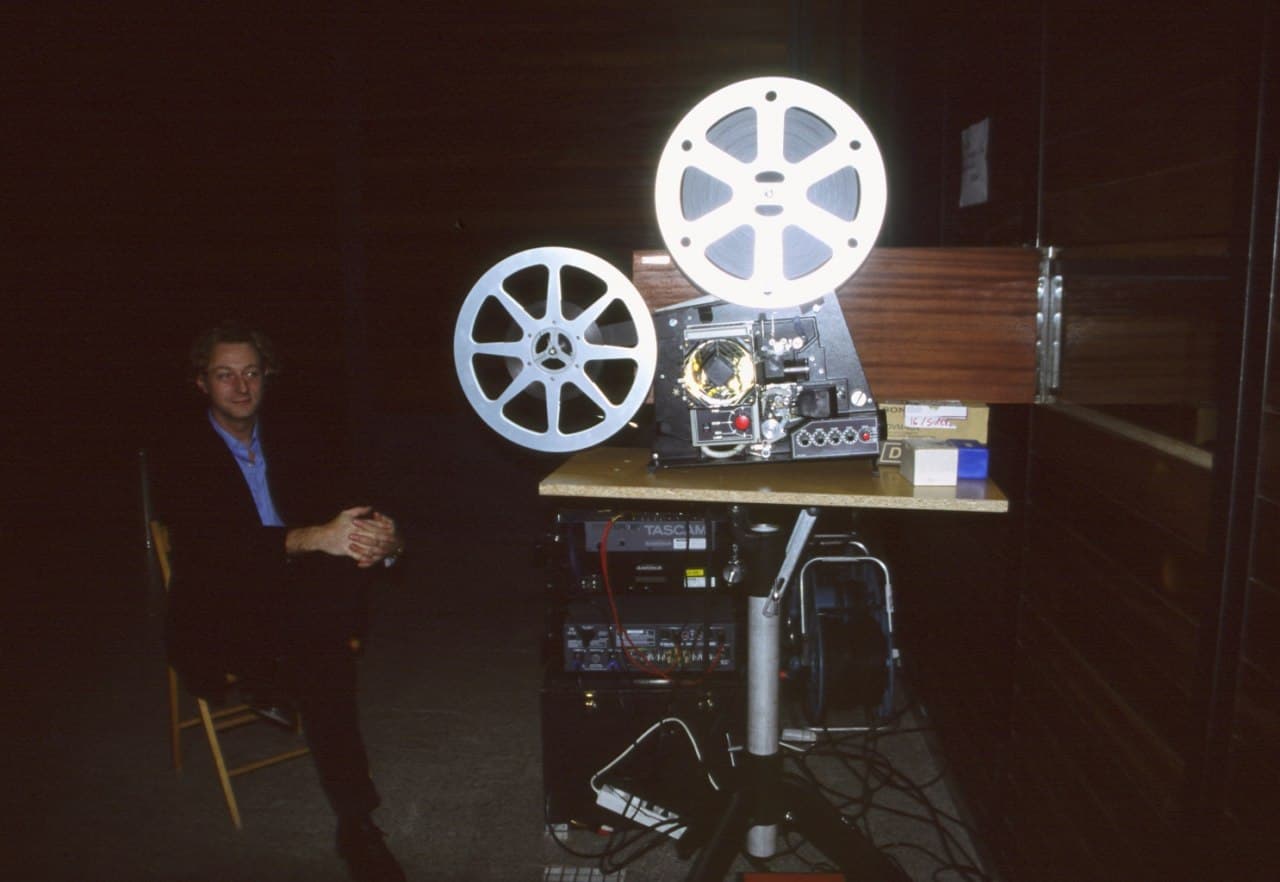
The Fumeo 9145 is, for me, the definitive super 8 projector for big screen
profesional presentations in comercial theaters with booth.
 |
| Rare Fumeo 9143 HTI250 Stereo, in IB Cinema |
In this series of ten articles, a digest of the one published in the international magazine SilverGrain Classics, are described the most interesting projectors to buy, depending on the use they will be put to.