Mostrando entradas con la etiqueta Fujicascope SD25. Mostrar todas las entradas

martes, 17 de septiembre de 2024

RERECORD DUBBING OF A BRITISH SUPER-8 PRINT IN ENGLISH TO CASTILIAN SPANISH FROM A DIGITAL SOURCE.

For the purpose of synchronizing the Castilian Spanish dubbing in an English Super-8 feature film, I usually transfer the original version to track two first, and, then, I proceed to re-record the Spanish dubbing on track one.

HAL 9000 is supervising the redubbing... ;-)

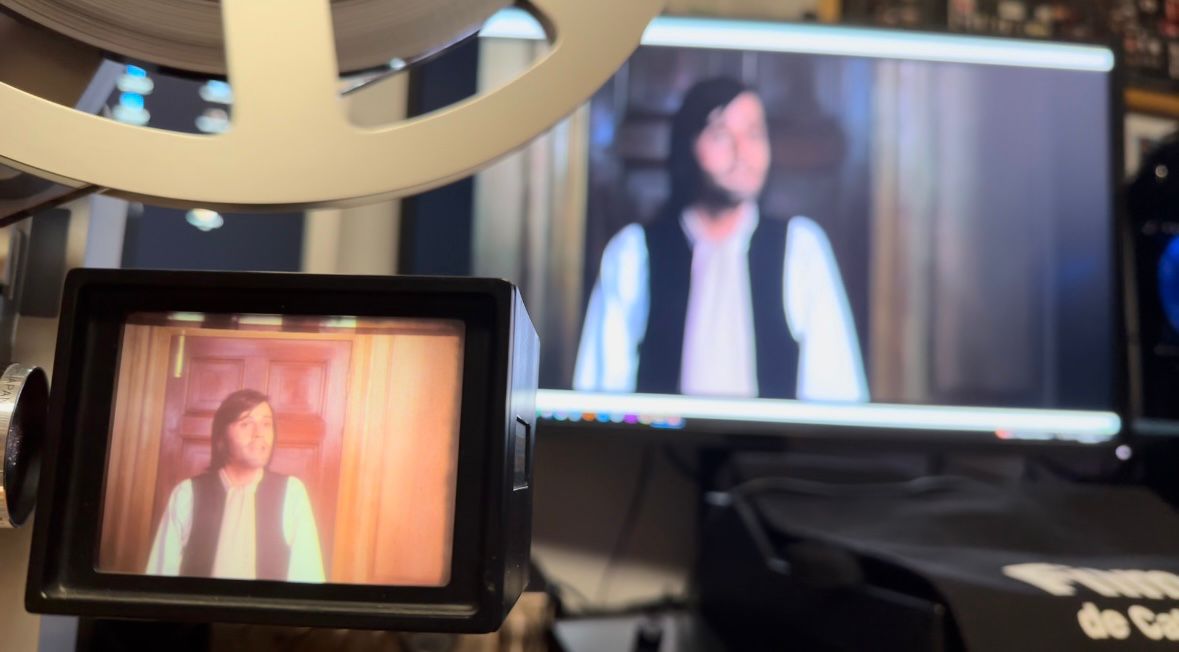
If the feature masters on both versions (digital and film) are very different, or the film positive has splices, then I usually sound with a Goko Stereo Moviola, or any of its clones, but in Mark-2 version, with the fine  adjustment of cadence at hand on its side (not in the back), and ultra-bright lighting to compare the moviola screen with the monitor screen with the picture of the digital source.

Just the same picture both in film and digital screen

In this case, for Hammer´s "Dr. Jekyll and sister Hyde", distribuited by Derann Films, since the master of the digital version and the one of the film version are almost the same, I decided to do the rerecord with the Fujicascope SD25, which has a quartz speed lock, and, as in other times,  to change the rate of the digital version from 25 to 24 frames per second with Premiere.

Projector with Quartz lock

However, for some reason, this modification of cadence in this case did not work, and I had to sound the film at the strange speed of 23.9 frames per second. This rerecord dubbing with sync sound, which combines technique with craftsmanship, is a laborious and time-consuming task but is rewarded when you see the results.

Lip Sync

In this specific case of this film title, I record the Spanish dubbing on both tracks, since track 1 has some problem in its composition and the sound obtained is low. When I show the film, I will have to play both tracks at the same time.

martes, 5 de enero de 2021

WHICH SUPER-8 PROJECTORS TO BUY? HIGH-END MACHINES (Part 9 of 10)

In this installment nine of a ten parts article originally published, in extended version by SilverGrain Classics magazine,  I write about projectors in the premium class category for the keen ciné enthusiast, as the Fujicascope SH30, Fujicascope SD25, the Bauer Studio range of projectors, the Elmo GS1200, the Beaulieu Studio, the Fumeo 9119 and the Braun Visacustic 2000.

Fujicascope SD25 Stereo Quartz

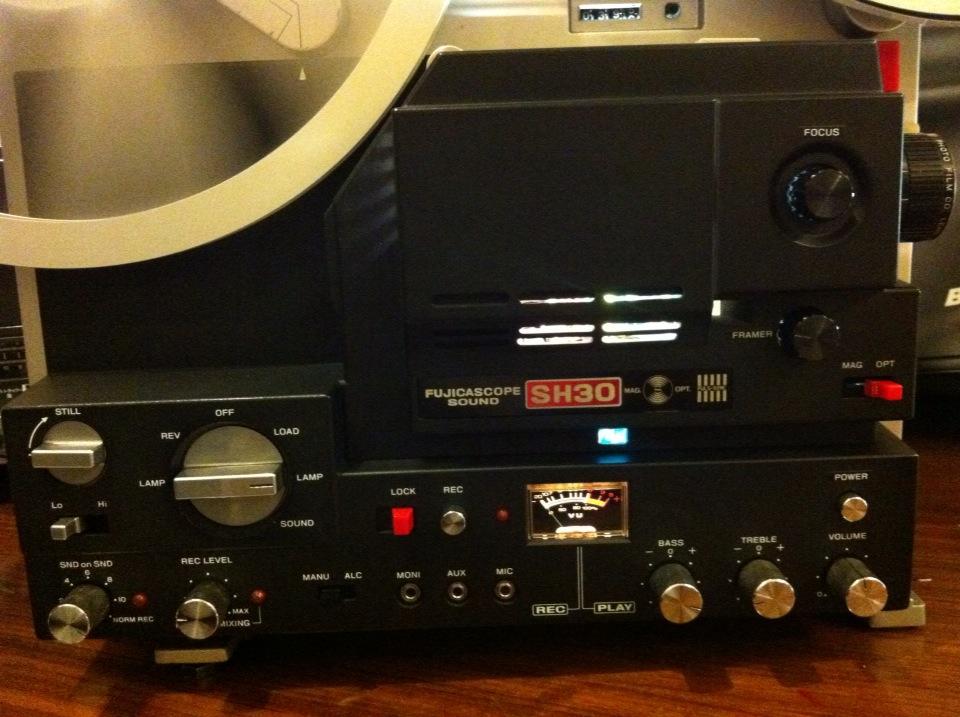
FUJICASCOPE SH30 and SD25. The Fujicascope SH30, introduced in 1975, was a projector ahead of its time, with a f1.0 14-28mm zoom lens, fine speed and a sophisticated electronic control (originally conceived to synchronize sound by electronic impulses or link two projectors for stereoscopy)

More complex electronically, and with stereo sound, is the Fujicascope SD25, with the same 1.0 lens and 360 meters reels capacity too, but a very useful speed control by quartz, microcomputer, and large digital frame reader. I use the Fujicascope SD25 to build the sound recordings in my movies. 

Fujicascope SH30

After the collapse of the Super-8 market, this model was sold at a fraction of its cost, in some markets,  as the Yelco 3600 (but with an inferior lens than the original Fujinon 1.0). Also interesting is its younger brother the Fujicascope SD20, with no microprocessor, but retaining the lens and quartz speed control. Quartz is essential when it comes to synchronizing with external devices such as a Blu Ray. In the Fujicascope SD25, being the filmmaker able to see the speed on the LED display, is possible to vary it at will when desired from 16 to 26 f.p.s. 

This 3 Fujicascope projectors use the 150 W lamp with good light output, because the fast pull-down of the claw. The excellent electronics giving good sound quality  with plenty of outlut power. 


The LED digital frame-counter is superb in the SD25, as also the microprocessor system for pre-programming. One strong point of this projectors are the magnetic head, of sendust type, able to last a lot of time! In facts, machines like this were used by Perry´s Movies, in London, to record the sound of commercial prints sold by this company. Further, this 3 Fujicascope sisters can play optical tracks, too.

A very clever design feature, on the Fujicascope SD25 Stereo Quartz (and SD20), for the independent filmmaker, is that all the sound inputs, which allow recording of complex tracks, are located on the front of the projector, and not on the back or the side.

Braun Visacustic 2000 with original Iscomorphot anamorphic

BRAUN VISACUSTIC 2000 DIGITAL. More than 40 years after its commercialization, the Braun Visacustic still attracts attention for its exterior design (which seduced Steve Jobs himself. He ordered two units of the 2000 Digital in Lee's Cameras, in 1983, which were personally delivered to him in his house in Belgravia by Martin Lee himself.  However, the best of Visacustic is inside:

1) Rear sprung pressure plate (in the lamp side), as in the Beaulieu (which allows project film with different thickness without the need to correct the focus) --more about this feature in installment 6 of this series--


2) Speeds of 16 2/3 and 25 f.p.s., in addition to the normal ones, as well as fine adjustment;

3) easy unthreading of a parcially projected film;

4) very fast pull down of the claw (for maximum light output of the 150 W lamp);
5) rounded edge projection frame;
6) swing open type lens holder; and
7) easy external electronic control, to enslave the machine with a Blu Ray reader or a quartz device.

The
 Braun Visacustic 2000 comes  with the famous Schneider f 1.1 11 - 30 mm. But few know that in the Braun company a female technique with eagle eyes (called Eva, perhaps?) tested the lenses individually, and the ones that did not meet the ideal characteristics were returned to the lens factory and perhaps sold to other makers: that's why all projections with a Visacustic 2000 look so sharp!


BEAULIEU STEREO STUDIO: A LIGHTHOUSE WITH A CHEAP LAMP.
The Beaulieu Stereo Studio halogen provides more light than the Elmo GS1200. How is it possible, if the Beaulieu use the inexpensive 150W lamp, instead of the expensive and hard to find 200W of the Elmo? One of the reasons is that the Beaulieu has a variable shutter, which allows the blades to be reduced from 3 to 2. 
But how does it get more light than the Fumeo 9119, which has a two-bladed shutter and the same expensive 200W ESC lamp of the Elmo GS1200?  

The explanation is its ultra-fast pull down in the Beaulieu, which allows each blade of the shutter to be reduced to just 40 degrees, instead of the Elmo's 60 degrees.
I love the Studio Stereo for syncing feature film audio in one go, from a digital source.


OTHER SPECIAL CHARACTERISTICS OF THE BEAULIEU STUDIO:
1) Rear sprung pressure in the side of the lamp: this allows to project films of different thicknesses without the need to correct the focus (for example, polyester with triacetate), with swing open type lens holder;
2) Micrometric focus: the most perfect ever made for Super-8, equaled only by the latest Fumeo series.
3) Variable shutter of 3 to 2 blades: this is important to achieve screens of six meters wide at 24 frames per second; also, to transfer to digital.
4) Fixed speeds but also variable speed: very important to transfer to digital.
5) Spectacular stereo-sound console with slider.
6) Able to accept 700 meters reels of triacetate (a complete feature film).   
Other interesting projectors from Beaulieu are the older models, as the standard EL Stereo (with mechanical VUmeters) and the Beaulieu Twin Track monophonic.


ELMO GS1200. The Japanese firm Elmo introduced its first GS1200 in 1978. Four series and several versions were made, such as PCom, HTI or xenon. The design concept was crazy and beautifully complicated: in place of one or two motors with several transmission systems, four motors! (in fact, is one of only two projectors with 4 motors)


The best of the Elmo GS1200 are the lenses. As standard, the f 1.1 12.5- 25mm is very good. But, pptionally, are available the non plus ultra of zoom lenses: f 1.0 12.5 - 30mm and the f 1.4 25-50mm long focal length lens (this long distance lens was improved to f 1.2 in later version, with an incredible optical quality, probably the best zoom ever made for Super-8. I have used the f 1.2 long distance zoom with the Elmo GS1200 in commercial theaters, over the years, with tip top results). 


The latest version of the GS1200, sold only in Germany, France and Spain, was the PCom, with a microprocessor with recording programs, a  noise reduction system, and a large LED frame counter. 

The Halogen Elmos GS1200 use the very special  and hard to find powerfull 24V 200W lamp code ESC (only produced in batchs). However, due to their slow pull down, with large blades in the shutter, Elmo GS1200 machines don't extract as much performance of the lamp as they could. 


The lens holder is of the swing open type: although without micrometrical focussing and with conventional pressure plate, is very easy to get focus even with th 1.0 lens.  Afer the gate, the Elmo GS1200 has a tendece  to be unkind with cement splices, in the lower loop and entry to sound section but this is not a trouble for me because I use always Fujifilm tape splices.

The comprehensive sound facilities, and the excellent arrangement of the two traks operation, in stereo, are a must for the filmmaker, with a logical and straighforward arrangement of the amplifier controls for the two channels. Magnetic head, as in the Fujicascope SD25 (and Goko editors) are "sendust", for very long life.  Of course, the Elmo GS1200 range has optical sound as standard (even, in Japan, was sold a version with only optical track reading!). 

Except for the first version of the GS1200, all the others support perfect sync with quartz devices currently built in Italy by Luigi Petrin and Renzo dal Bo

Elmo GS1200 are such an extraordinary projectors that one falls in love with them immediately. However, like beautiful lovers, apart from providing pleasure, it also generates a headaches; one problem with the Elmo GS1200 is that when they don't scratch the film in a place or other, then, they have an electronic or mechanical trouble: for this reason, the Elmo GS1200 are projectors that users like me love and hate at the same time!

Bauer T610. This is the top model of the Studio series of the German brand Bauer (models T502, T520, T525, T600 and T610), with stereo sound, a sophisticated electronic programming system and the Schneider f 1.1 11-30 mm as standard. The Studio class, very well made,  are the quietest projectors ever manufacturated.  


Its two drawbacks are the difficulty of unthreading the film in the middle of the projection and the plastic pressure gate. Neither, I don´t like the auto-thread mechanism, with automatically down the upper loop former, which is switched on every one that you try to stop the projection. But the pull-down claw mechanism is very well made and very kind with film.

Fumeo 9119. This is a 16 mm projector adapted in factory to project Super-8. The Fumeo 9119 was designed mainly as a projection-only machine (although it was sold as 9120 with recording option). This projector, very heavy,  transmit a solid engineering and feeling of quality. Picture on screen is so stable and so sharp thant the film grain can be clearly seen on screen, if the projector is with the optional Isco Cineluz f 1.1 11-30 mm lens.   The micrometrical focusing of later version is even better than the one of the Beaulieu, as the lens is placed in a lens holder and not fixed with a ring, so, the focus is held throught all the film. 

The sound quality is excellent and with a range of controls of frequency charasteristic much more comprehensive than are normally found in Super-8 projectors: there are three separate tone controls, provindig (each independently of others): 1) a bass rise or fall (giving un to more/minus  10dB at 10Hz. 2) A treble rise or fall (ut to more/minus 8db at 10 Kz). 3) A sharp rise in band of middle frequencies centred around 2Kz. Sound is very stable too, thanks to a fly wheel of more than 1 kg. of weight!  Projector can play also optical tracks. Standard 9119 was available with stereo magnetic heads as option.

Unlike the majority of lightweight 8 mm projectors, this Fumeo is of all-metal construction with minimal use of plastics. The main body, the back cover and the lampouse are all light-alloy die-castings, aa very strong and rigid assembly. 

Experienced projectionists will  be delighted to see this machine does not have automatic threading. It is assumed that the projector will be hadled ontly by a capable operator: threading and unthreading is manual. It is a machine designed for constant heavy use with regular mantenance (for example, as described in manual, oiling the felt pad on the claw cam after each 40 hours, and other adjustaments).  

The claw pull-down is not very fast, so, the blade sectors are of 60 degrees but the machine is with 2 blades instead 3 blades are usual in Super-8: so, a lot of light reach the screen from the 200W ESC (the very same that Elmo Gs1200), despite despite the fact that the lamp is at a further distance than the regulation. 

The drive motor is a large mains-voltage induction motor runing at constant speed: so, no brushes to clean in this kind of industrial motor. Projector has also provision for playing optical sound tracks. 


With regular lubrication, a Fumeo 9119 projector should out last our life. The provision  for really large reels of film, up to 800 meters. A very stron point is than spares for Fumeo 9119 are still available via Marco Sonetti in marks22son@gmail.com: Marco was a personal friend of Angelo Bianchi, the owner of Fumeo, and bought all the inventary of the beloved Italian factory. Stereo heads for Fumeo projectors are still made today!


What is my recommendation? If budget is a consideration and stereophony is not necessary, and you are looking for a reliable and easy to maintain projector, my recommendation is the Fujicascope SH30 (if you are looking for quartz precision as well, then the Fujicascope SD25 -or its Yelco 3600 clone, which, however, comes with a mediocre lens). 

If you value good design, in every way, and you have little space at home,  then you should to choose the Steve Jobs's projector: the Braun Visacustic 2000. Anyone looking for a quiet projector has any of the Bauer Studio range (Braun and Bauer are both for 240 meters reels only)

If in addition to being a filmmaker, you are a film-collector of feature films, then the Beulieu Studio. If you are only going to project movies, without recording sound, and you are looking for a projector that can last for eternity... and beyond, then, there is no other option than the Fumeo 9119. 

Elmo GS1200 is a magic projector but I do not recommend for isolated filmmakers because, for one reason or another, they are a source of problems: from scratches in the movies to failures in electronics or mechanics (I know, because I own the Elmo GS1200 IV, the PCom and the Xenon). All the faults in the Elmo GS1200 can be solved, but not everyone has access to a competent technician near home, like the Italian Luigi Petrin.

In this series of ten articles, a digest of the one published in the international magazine SilverGrain Classics, are described the most interesting projectors to buy, depending on the use they will be put to. 

Originally published in SilverGrain Classics


Which is the best zoom to buy? Article about high quality zooms in European size.


jueves, 3 de octubre de 2019

COMO SINCRONIZAR EL DOBLAJE EN ESPAÑOL EN UNA PELÍCULA CON SONIDO MAGNÉTICO

Derann Films sólo pudo hacer un tiraje de diez copias cinematográficas de la obra maestra de los estudios Aardmann "A grand day out", naturalmente, con banda sonora en inglés. 
Durante algún tiempo, la tuve con el doblaje en español castellano ¡hasta que descubrí que uno de los dos doblajes en español latino, el hecho en Venezuela, era mucho mejor!
Finalmente, repiqué este doblaje a mi positivo cinematográfico. Para el repicado con sincronismo labial, resulta muy útil un proyector con arranque instantáneo a partir de pausa, ajuste fino de cadencia que, además, tenga módulo de cuarzo o al que se le pueda añadir, para mantener la sincronización perfecta entre la versión digital, con el doblaje a transferir, y la película. 
Los proyectores que cuentan con modulo de cuarzo de origen son: el Fujicascope SD25, el Fujicascope SD20, el Yelco 3600 y el Yelco 810, pero también se le puede añadir el módulo de cuarzo hecho por Luigi Petrin al popular Elmo GS1200 y al buscadísimo Fujicascope SH30. 

lunes, 12 de noviembre de 2018

MICKEY: UN ANCIANO MUY JOVEN

Este mes de noviembre el ratón mas famoso del mundo, Mickey (Miguelito en México, Topolino en Italia o ¡Pérez, durante la II República española!), cumple 90 años. Con tal motivo, vamos a hacerle una sesión conmemorativa en la escuela del ayuntamiento de Cabanas, en la provincia coruñesa, en Galicia, sesión con la que pasaremos repaso a los principales hitos cinematográficos que jalonan la carrera del que, con sus orejotas y el sombrero de mago de la memorable "El aprendiz de brujo", se ha convertido en la imagen icónica del primer imperio mundial del entretenimiento.
Aunque ya hemos tramitado los derechos de exhibición con el distribuidor de Walt Disney en este territorio, el contenido digital dura demasiado para una audiencia de niños pequeños, de forma que llevé a cabo una selección, de mas o menos una hora, que, además, proyectaremos con película de cine. 
Después de elegir los títulos, de los cuales ya hablaremos en su momento, lo primero consiste en empalmar los cortos cinematográficos en una bobina grande. Como se encuentran en inglés, del archivo digital proporcionado por The Walt Disney Company transfiero, a una de la pistas de las películas, los doblajes en español. Ello nos priva escuchar al propio Walt Disney que, durante la primera etapa en la filmografía de Mickey, ¡era el encargado de darle voz! pero, ante una audiencia infantil, se precisa proyectar versiones dobladas. 
Las labores de sincronización las hago con el Fujicascope SD25 Quartz que, con la precisión del cuarzo, me permite sincronizar la señal electrónica en la película fotoquímica. El problema, con los títulos mas antiguos, es que ¡la versión digital tiene algunas escenas más cortas! 

Es ésta, la consecución de la sincronía, una labor que aúna la experiencia digital con el conocimiento técnico, y que mezcla tecnología de última generación con  principios sonoros de los años treinta ¡y químicos de finales del pasado siglo! Lástima que sea un trabajo que permanece silente, en la trastienda, sin que trascienda.
Si la fuente digital es un Blu Ray o un DCP el cuarzo del proyector se puede bloquear a 24 fotogramas por segundo. Esto, no obstante, no asegura la sincronía en películas antiguas pues en las nuevas versiones ¡no es raro que falten secuencias! o haya planos con distintas duraciones. 
Si la fuente es un DVD, el proyector debe ajustarse a 25 fotogramas por segundo y, después, ir variando imperceptible fracciones milimétricas de forma que no se pierda la sincronía.

sábado, 20 de enero de 2018

FUJICASCOPE SD25 QUARTZ COMPUTER: MI APARATO FAVORITO PARA SONORIZAR SÚPER-8

La mayor parte de los cineístas que se sirven actualmente, de forma profesional o artística, del Súper-8, graban las bandas sonoras de sus películas con ordenador. Las ventajas son obvias: como, en digital, se emplean pistas independientes, los errores se solucionan en un santiamén: no hay arte ni destreza, es un proceso meramente automático.
Uno, que ha sonorizado también varias películas de Súper-8 sirviéndose de la facilidad de lo digital, prefiere, sin embargo, hacerlo en las bandas magnéticas que, tras el revelado, aplica a la película positiva, pese a que la dificultad es notoria, por todos los pasos que hay que seguir sin margen al error: 
1) sincronizar el sonido directo, si lo hay;
2) añadir la música;
3) hacer lo propio con efectos de biblioteca; y
4) proceder a la locución. 
Cada fase, se hace en superposición, de forma que un error en, por ejemplo, la locución, como ésta no va en pista independiente, o se deja tal y como se grabó, o resulta menester repetir todas y cada una de las fases previas de grabación sonora de esa secuencia.
FUJICASCOPE SD25 QUARTZ COMPUTER
Mi proyector favorito para la sonorización es el Fujicascope SD25 por varias delicias técnicas sin paralelo:
1) avance o retroceso lento con precisión de fotograma, gracias a su contador digital;
2) arranque instantáneo de la película desde la posición de pausa, fundamental para efectos de librería;
3) velocidad controlada por mecanismo de cuarzo; 
4) admite constantes marcha adelante y atrás, sin deterioro o arañazos en la película, aunque cuente con cientos de empalmes;
5) facilidad de desenhebrado; 
y 6) extrema dureza de sus cabezales.
A la hora de proyectar es otra historia, pero para sonorizar pistas complejas, sin deterioro en la película, no hay mas opción que el Fujicascope SD25 (o su clon). 
Tiene, el Fujicascope SD25, dos únicos inconvenientes: 1) ¡¡¡funciona a 100 V!!!, de forma que se precisa un transformador especial que sólo se vende en Japón, 
y 2) las indicativos recordatorios de las distintas funciones e instrucciones se encuentran en ¡¡¡japonés!!!   
Afortunamente, mi amigo Tak Kohyama las tradujo al inglés y, de este idioma, lo pasé al español. 
Estos proyectores son vendidos en exclusiva por Retro Enterprises, de Tokio.

martes, 30 de mayo de 2017

FUJICASCOPE SH 30: CON UNA PELÍCULA NO APTA PARA MARIQUITAS

Sorprende, en este resumen en Súper-8 de "Blancanieves", comercializado por la compañía Disney desde Francia para el mercado español a principios de los setenta, que Gruñón proteste, o "rosme", que diríamos en gallego, contra los otros enanos cuando se asean diciendo "Bah, grupo de mariquitas"
En aquella época, durante mi infancia, la compañía del ratón vendía para su uso no comercial resúmenes de unos ocho minutos de sus clásicos, tanto en versión sonora, como muda con subtítulos. ¿Alguien se imagina ese texto proyectado hoy en día? ¡Les caería una denuncia por homofobia!, probablemente
ADMIRABLE DISEÑO.
Valoro mucho el cuidadoso trabajo artístico de estas cajitas de Súper-8 de la Disney, aunque mis favoritas, en cuanto a diseño, eran las de Castle Films antes de que la compañía fuese adquirida por Universal. La impresión no es en offsett, sino litografiada en cartón. 
Este digesto de "Blancanieves", uno de los pocos resúmenes que compró mi padre, lleva en mi familia desde 1971: lo habré visto miles de veces, durante los años setenta.  Son estas pequeñas obritas las que sembraron en mí el espíritu coleccionista y quien me diría, cuando tenía once años, que con el tiempo ¡¡¡iba a disponer del largometraje completo en varias versiones cinematográficas!!! (dos de Súper-8, una de Derann y otra, italiana, "pirata";  en 16 mm -en inglés-,   y en 35 mm -con el doblaje de Edmundo Santos-, estas dos últimas, directamente de los archivos Buena Vista para mi colección,  al cerrar la compañía del ratón su división non theatrical).
Lo de "Bah. Grupo de mariquitas" no es la única "incorrección política" de este resumen setentero. En la propia caja, para advertir que los subtítulos se encuentran en español, en el colmo de estereotipo, ¡¡¡emplean un sombrero mexicano!!! Supongo que a alguien, en la multinacional, le habrá parecido, en su día, una ocurrencia graciosa. Lo curioso es que el español que se usa en los textos es el castellano, y no el latinoamericano.
Revisando la copia de este resumen, en triacetato de AGFA, estoy asombrado de lo sorprendentemente bien que se conserva. Como puede verse en el vídeo grabado con el móvil enlazado al término de esta entrada, pese al casi medio siglo transcurrido desde que el metraje saliese del laboratorio francés, los colores se conservan intactos.
FUJICASCOPE SH30.
La proyección de prueba la llevo a cabo con el Fujicascope SH30 que fuera, durante mi adolescencia y juventud, un inalcanzable objeto del deseo; fue diseñado por Fujifilm como el compañero ideal para la Fujica ZC1000. ¡Todavía la recuerdo, cada nueva edición de Sonimag, en el espacio de Mampel Asens!, antes de que la firma fuese comprada por Fujifilm.
El Fujicascope SH30, cuyo diseño se mostró al mundo en 1975, cuando yo tenía quince años, fue puesto a la venta en España a partir de 1976. 
En ese momento, fue el mejor proyector del mundo:
1) con capacidad para reproducir tres sistemas de sonido (magnético, óptico y de sincronismo por impulsos); 
2) objetivo Fujinon f 1.0 de 14-28 mm (opcionales, un f 1.2 20-40 mm y un económico f 1.3)
3) paro con imagen en proyección (virtud novedosa en un proyector sonoro y muy importante a la hora de sonorizar)
4) portaobjetivos de abertura total; 
5) posibilidad de desenhebrar la película en pocos segundos; 
6) extremadamente cuidadoso con la misma (en lugar de patín de entrada, por ejemplo, como se puede ver en el vídeo mas abajo, hay dos rodillos giratorios)
7) capacidad para bobinas de 360 metros de triacetato (o 540 metros de poliéster Fujifilm Single-8)
9) transmisión con cadena metálica; 
10) lámpara DNF de 150 W; 
11) diseño y construcción sin tener en cuenta la obsolescencia programada.
EL SONIDO DE FUJICASCOPE SH30.
El sonido, aunque monofónico, es asombrosamente maravilloso. Si se conecta al amplificador de un cine, el Fujicascope SH30 es, junto con el Fumeo, el único proyector en que el oído avezado no puede advertir la diferencia entre el movimiento intermitente de la ventanilla y el continuo en el cabezal de lectura magnética, debido, en este caso, a un ingenioso dispositivo que amortigua la vibración de la película justo antes de que entre en el cabezal.
¡QUÉ PENA!
Resulta descorazonador que, cuando Fujfilm, pocos años más tarde, desarrolló sus Fujicascope SD20 y SD25, ambos capaces de leer las dos pistas sonoras y con tecnología de cuarzo, no lo hiciera tomando como base el SH30. Un SD25 en el cuerpo de un SH30 habría dado lugar al mejor proyector del mundo.
FRAGMENTO DE PROYECCIÓN.
En el siguiente vídeo, grabado con el móvil, se puede ver al Fujicascope SH30 en acción, con detención de la imagen proyectada en la secuencia políticamente incorrecta anteriormente descrita.