Mostrando entradas con la etiqueta Braun Visacustic 2000 Digital. Mostrar todas las entradas

sábado, 2 de noviembre de 2024

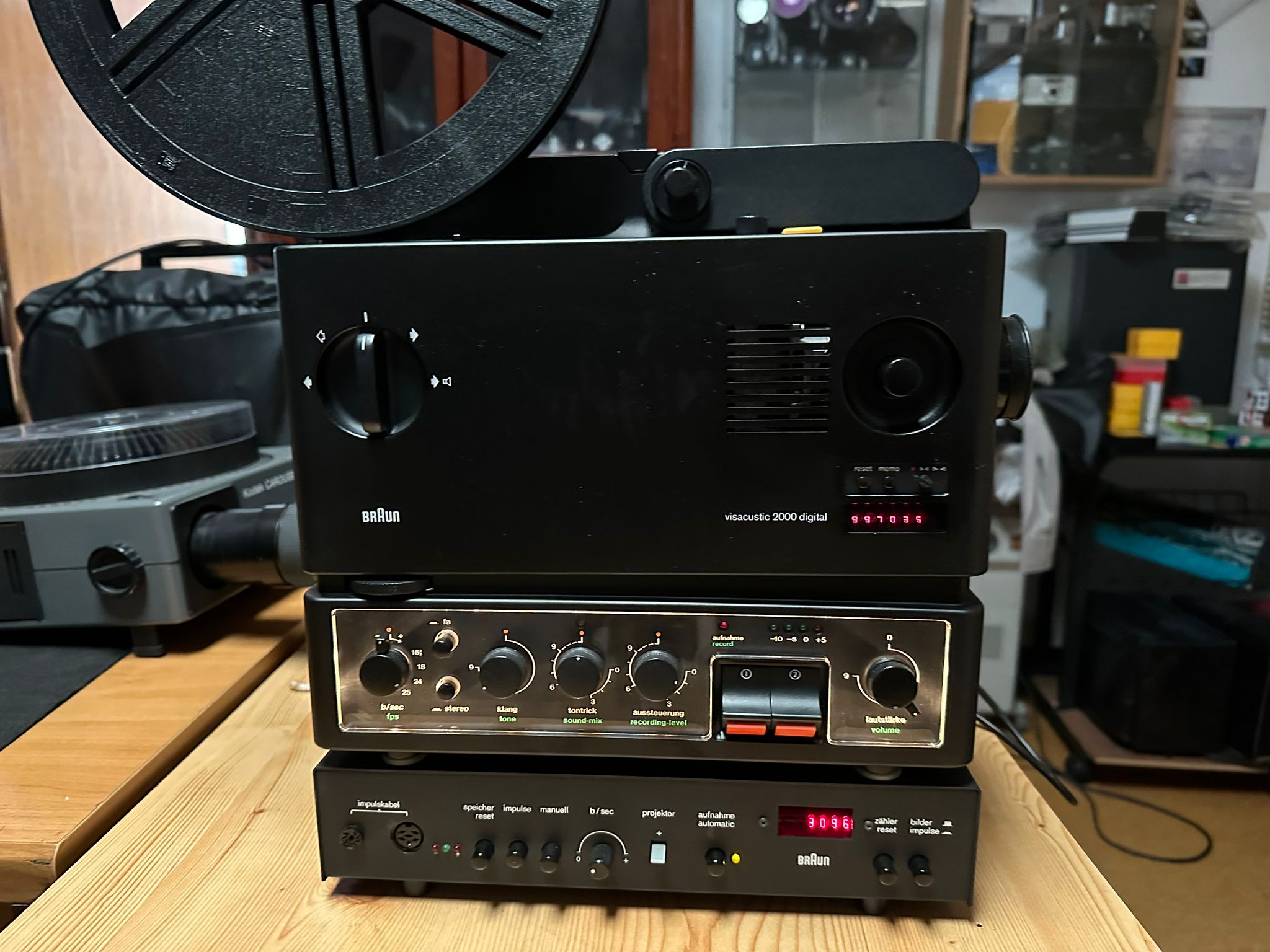
BRAUN VISACUSTIC 2000: ¿CÓMO EXTRAER EL OBJETIVO?

Varias veces, en esta bitácora, nos hemos ocupado del excelente proyector de Súper-8 Braun Visacustic 2000 Digital, con instrucciones para diversos mantenimientos (localízenlas a través de buscador), como los secretos para el cambio de correas. 

Hoy explicaremos algo muy sencillo pero que, cuando se usan varios proyectores de distintas marcas, a veces se olvida: la extracción de su objetivo, para su necesaria limpieza, o para sustituirlo por otro, como es este el caso, cambiando el objetivo Isco CinemaScope por el objetivo normal Schneider f 1.1 11-30 mm.

El Schneider, en los Braun Visacustic, ofrece resultados asombrosamente buenos uniforme en todas las unidades, pues Braun tenía una técnica que uno a uno los probaba en cada proyector: los que no cumplían sus requisitos, eran devueltos a fábrica, donde probablemente los enviaban a otros fabricantes menos rigurosos. 

En el Braun Visacustic 2000, para extraer el objetivo, hay que seguir los siguientes pasos:

1) Extraer la tapa frontal; 

2) Girar hacia la derecha, en el sentido de las agujas del reloj, el botón del mando del enfoque;

3) Cuando esté a tope, empujar el objetivo hacia dentro. Una vez dentro, ello permite girar un poco mas a la derecha el mando del enfoque mientras se observa como una muesca del conjunto de enfoque deja espacio para un pequeño bulón cilíndrico del propio objetivo.  

Muesca en la trasera de la perilla de enfoque que franquea el paso para el bulón del objetivo

4) Extraer con cuidado pues, tras el objetivo, hay un muelle.

Para montarlo, hay que repetir la operación a la inversa. 

OTROS CONSEJOS PARA EL VISACUSTIC 2000.

1) Aun guardado con funda, su magnífico objetivo se merece una tapa. Su diámetro es 40 mm.

2) Este aparato necesita un uso regular sobre todo por su electrónica. Una vez al mes puede ser suficiente.

  • EN SÚPER-8, ¿CÓMO ES POSIBLE? ¿DÓNDE COMPRAR ARTÍCULOS DE SÚPER-8? 
Siempre recomiendo la misma tienda que usa Steven Spielberg, Spike Lee o J.J. Abrams, entre otras luminarias:  Pro 8 mm, de Hollywood. 
Los propietarios, Rhonda y Phil, son los creadores del formato Max-8, que proporciona con óptica normal un formato casi de 1.85, en lugar del tradicional académico.
Atienden en español e inglés, en el siguiente enlace, ¡y el envio a Europa demora sólo 3 días!:  
https://www.pro8mm.com?sca_ref=221762.t1gzXnwJIC

martes, 22 de junio de 2021

BRAUN VISACUSTIC 2000 DIGITAL: REPARADO ¡EN MI PROPIA CIUDAD!

El proyector de Súper-8 de Steve Jobs, como ya revelé varias veces en esta bitácora, es una máquina de la cual no puedo hablar mas que bien: el Braun Visacustic 2000 Digital, con sonido estereofónico, contador digital, vúmetro digital y presor trasero, con portaobjetivos de abertura total. Su objetivo, el famoso Schneider f 1.1 de 11-30 mm, era individualmente probado antes de instalarlo y, los que no reunían las prestaciones, devueltos a Schneider. ¡Ni Bauer, Beaulieu o Fumeo tenían tal control de calidad!

40 años después de fabricados, el talón de Aquiles de estos proyectores es su sofisticada electrónica. Menos mal que, en mi ciudad, mi amigo de décadas José Manuel Pérez Romero, Mr. Fuji Xerox como es conocido, es una especie de McGyver de la electrónica y la mecánica: tiene un talento especial que le hace vislumbrar la solución para cualquier problema, donde otros se ven obligados a tirar la toalla. ¡Nada hay imposible para él! 

A mi Braun Visacustic 2000 le había dejado de funcionar tanto el vúmetro de LEDs como el contador digital. José Manuel descubrió que el fallo era un condensador en cortocircuito que hacía caer la tensión, calentaba una resistencia y dejaba inactivo el contador digital, al mismo tiempo que hacía que se pusiese en marcha el motor como si estuviese enhebrando la película.

José Manuel que, además, es una admirador de la electrónica de Braun (firma que estos días cumple cien años), disfrutó localizando los fallos ¡sin esquema alguno! y sustituyendo los componentes originales. ¡Ya tengo el Braun Visacustic 2000 Digital listo para otros 40 años de servicio! 


martes, 5 de enero de 2021

WHICH SUPER-8 PROJECTORS TO BUY? HIGH-END MACHINES (Part 9 of 10)

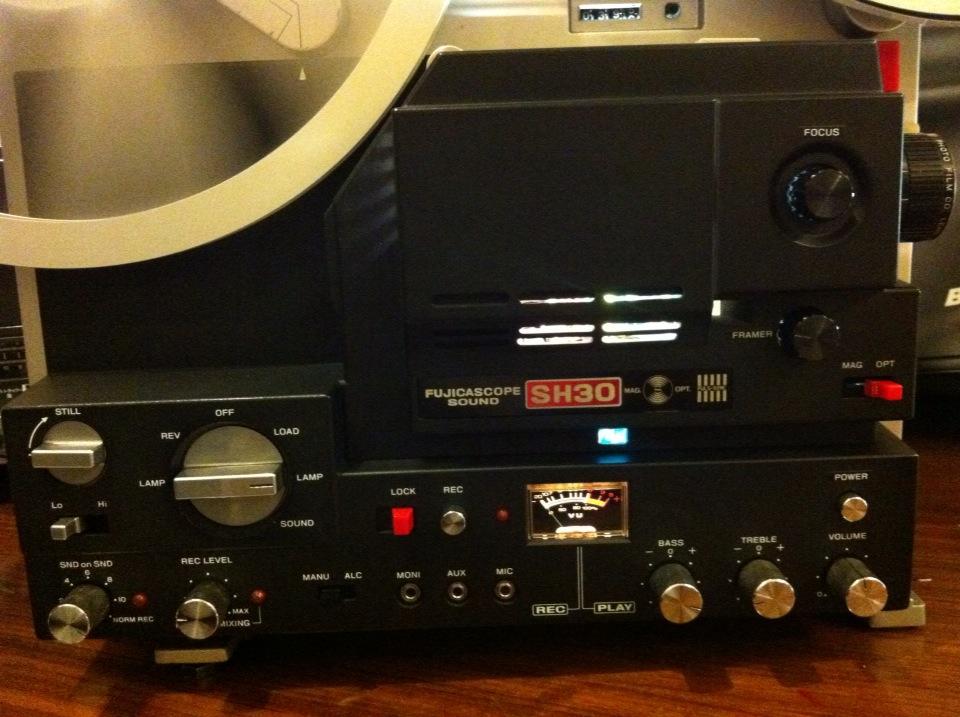
In this installment nine of a ten parts article originally published, in extended version by SilverGrain Classics magazine,  I write about projectors in the premium class category for the keen ciné enthusiast, as the Fujicascope SH30, Fujicascope SD25, the Bauer Studio range of projectors, the Elmo GS1200, the Beaulieu Studio, the Fumeo 9119 and the Braun Visacustic 2000.

Fujicascope SD25 Stereo Quartz

FUJICASCOPE SH30 and SD25. The Fujicascope SH30, introduced in 1975, was a projector ahead of its time, with a f1.0 14-28mm zoom lens, fine speed and a sophisticated electronic control (originally conceived to synchronize sound by electronic impulses or link two projectors for stereoscopy)

More complex electronically, and with stereo sound, is the Fujicascope SD25, with the same 1.0 lens and 360 meters reels capacity too, but a very useful speed control by quartz, microcomputer, and large digital frame reader. I use the Fujicascope SD25 to build the sound recordings in my movies. 

Fujicascope SH30

After the collapse of the Super-8 market, this model was sold at a fraction of its cost, in some markets,  as the Yelco 3600 (but with an inferior lens than the original Fujinon 1.0). Also interesting is its younger brother the Fujicascope SD20, with no microprocessor, but retaining the lens and quartz speed control. Quartz is essential when it comes to synchronizing with external devices such as a Blu Ray. In the Fujicascope SD25, being the filmmaker able to see the speed on the LED display, is possible to vary it at will when desired from 16 to 26 f.p.s. 

This 3 Fujicascope projectors use the 150 W lamp with good light output, because the fast pull-down of the claw. The excellent electronics giving good sound quality  with plenty of outlut power. 


The LED digital frame-counter is superb in the SD25, as also the microprocessor system for pre-programming. One strong point of this projectors are the magnetic head, of sendust type, able to last a lot of time! In facts, machines like this were used by Perry´s Movies, in London, to record the sound of commercial prints sold by this company. Further, this 3 Fujicascope sisters can play optical tracks, too.

A very clever design feature, on the Fujicascope SD25 Stereo Quartz (and SD20), for the independent filmmaker, is that all the sound inputs, which allow recording of complex tracks, are located on the front of the projector, and not on the back or the side.

Braun Visacustic 2000 with original Iscomorphot anamorphic

BRAUN VISACUSTIC 2000 DIGITAL. More than 40 years after its commercialization, the Braun Visacustic still attracts attention for its exterior design (which seduced Steve Jobs himself. He ordered two units of the 2000 Digital in Lee's Cameras, in 1983, which were personally delivered to him in his house in Belgravia by Martin Lee himself.  However, the best of Visacustic is inside:

1) Rear sprung pressure plate (in the lamp side), as in the Beaulieu (which allows project film with different thickness without the need to correct the focus) --more about this feature in installment 6 of this series--


2) Speeds of 16 2/3 and 25 f.p.s., in addition to the normal ones, as well as fine adjustment;

3) easy unthreading of a parcially projected film;

4) very fast pull down of the claw (for maximum light output of the 150 W lamp);
5) rounded edge projection frame;
6) swing open type lens holder; and
7) easy external electronic control, to enslave the machine with a Blu Ray reader or a quartz device.

The
 Braun Visacustic 2000 comes  with the famous Schneider f 1.1 11 - 30 mm. But few know that in the Braun company a female technique with eagle eyes (called Eva, perhaps?) tested the lenses individually, and the ones that did not meet the ideal characteristics were returned to the lens factory and perhaps sold to other makers: that's why all projections with a Visacustic 2000 look so sharp!


BEAULIEU STEREO STUDIO: A LIGHTHOUSE WITH A CHEAP LAMP.
The Beaulieu Stereo Studio halogen provides more light than the Elmo GS1200. How is it possible, if the Beaulieu use the inexpensive 150W lamp, instead of the expensive and hard to find 200W of the Elmo? One of the reasons is that the Beaulieu has a variable shutter, which allows the blades to be reduced from 3 to 2. 
But how does it get more light than the Fumeo 9119, which has a two-bladed shutter and the same expensive 200W ESC lamp of the Elmo GS1200?  

The explanation is its ultra-fast pull down in the Beaulieu, which allows each blade of the shutter to be reduced to just 40 degrees, instead of the Elmo's 60 degrees.
I love the Studio Stereo for syncing feature film audio in one go, from a digital source.


OTHER SPECIAL CHARACTERISTICS OF THE BEAULIEU STUDIO:
1) Rear sprung pressure in the side of the lamp: this allows to project films of different thicknesses without the need to correct the focus (for example, polyester with triacetate), with swing open type lens holder;
2) Micrometric focus: the most perfect ever made for Super-8, equaled only by the latest Fumeo series.
3) Variable shutter of 3 to 2 blades: this is important to achieve screens of six meters wide at 24 frames per second; also, to transfer to digital.
4) Fixed speeds but also variable speed: very important to transfer to digital.
5) Spectacular stereo-sound console with slider.
6) Able to accept 700 meters reels of triacetate (a complete feature film).   
Other interesting projectors from Beaulieu are the older models, as the standard EL Stereo (with mechanical VUmeters) and the Beaulieu Twin Track monophonic.


ELMO GS1200. The Japanese firm Elmo introduced its first GS1200 in 1978. Four series and several versions were made, such as PCom, HTI or xenon. The design concept was crazy and beautifully complicated: in place of one or two motors with several transmission systems, four motors! (in fact, is one of only two projectors with 4 motors)


The best of the Elmo GS1200 are the lenses. As standard, the f 1.1 12.5- 25mm is very good. But, pptionally, are available the non plus ultra of zoom lenses: f 1.0 12.5 - 30mm and the f 1.4 25-50mm long focal length lens (this long distance lens was improved to f 1.2 in later version, with an incredible optical quality, probably the best zoom ever made for Super-8. I have used the f 1.2 long distance zoom with the Elmo GS1200 in commercial theaters, over the years, with tip top results). 


The latest version of the GS1200, sold only in Germany, France and Spain, was the PCom, with a microprocessor with recording programs, a  noise reduction system, and a large LED frame counter. 

The Halogen Elmos GS1200 use the very special  and hard to find powerfull 24V 200W lamp code ESC (only produced in batchs). However, due to their slow pull down, with large blades in the shutter, Elmo GS1200 machines don't extract as much performance of the lamp as they could. 


The lens holder is of the swing open type: although without micrometrical focussing and with conventional pressure plate, is very easy to get focus even with th 1.0 lens.  Afer the gate, the Elmo GS1200 has a tendece  to be unkind with cement splices, in the lower loop and entry to sound section but this is not a trouble for me because I use always Fujifilm tape splices.

The comprehensive sound facilities, and the excellent arrangement of the two traks operation, in stereo, are a must for the filmmaker, with a logical and straighforward arrangement of the amplifier controls for the two channels. Magnetic head, as in the Fujicascope SD25 (and Goko editors) are "sendust", for very long life.  Of course, the Elmo GS1200 range has optical sound as standard (even, in Japan, was sold a version with only optical track reading!). 

Except for the first version of the GS1200, all the others support perfect sync with quartz devices currently built in Italy by Luigi Petrin and Renzo dal Bo

Elmo GS1200 are such an extraordinary projectors that one falls in love with them immediately. However, like beautiful lovers, apart from providing pleasure, it also generates a headaches; one problem with the Elmo GS1200 is that when they don't scratch the film in a place or other, then, they have an electronic or mechanical trouble: for this reason, the Elmo GS1200 are projectors that users like me love and hate at the same time!

Bauer T610. This is the top model of the Studio series of the German brand Bauer (models T502, T520, T525, T600 and T610), with stereo sound, a sophisticated electronic programming system and the Schneider f 1.1 11-30 mm as standard. The Studio class, very well made,  are the quietest projectors ever manufacturated.  


Its two drawbacks are the difficulty of unthreading the film in the middle of the projection and the plastic pressure gate. Neither, I don´t like the auto-thread mechanism, with automatically down the upper loop former, which is switched on every one that you try to stop the projection. But the pull-down claw mechanism is very well made and very kind with film.

Fumeo 9119. This is a 16 mm projector adapted in factory to project Super-8. The Fumeo 9119 was designed mainly as a projection-only machine (although it was sold as 9120 with recording option). This projector, very heavy,  transmit a solid engineering and feeling of quality. Picture on screen is so stable and so sharp thant the film grain can be clearly seen on screen, if the projector is with the optional Isco Cineluz f 1.1 11-30 mm lens.   The micrometrical focusing of later version is even better than the one of the Beaulieu, as the lens is placed in a lens holder and not fixed with a ring, so, the focus is held throught all the film. 

The sound quality is excellent and with a range of controls of frequency charasteristic much more comprehensive than are normally found in Super-8 projectors: there are three separate tone controls, provindig (each independently of others): 1) a bass rise or fall (giving un to more/minus  10dB at 10Hz. 2) A treble rise or fall (ut to more/minus 8db at 10 Kz). 3) A sharp rise in band of middle frequencies centred around 2Kz. Sound is very stable too, thanks to a fly wheel of more than 1 kg. of weight!  Projector can play also optical tracks. Standard 9119 was available with stereo magnetic heads as option.

Unlike the majority of lightweight 8 mm projectors, this Fumeo is of all-metal construction with minimal use of plastics. The main body, the back cover and the lampouse are all light-alloy die-castings, aa very strong and rigid assembly. 

Experienced projectionists will  be delighted to see this machine does not have automatic threading. It is assumed that the projector will be hadled ontly by a capable operator: threading and unthreading is manual. It is a machine designed for constant heavy use with regular mantenance (for example, as described in manual, oiling the felt pad on the claw cam after each 40 hours, and other adjustaments).  

The claw pull-down is not very fast, so, the blade sectors are of 60 degrees but the machine is with 2 blades instead 3 blades are usual in Super-8: so, a lot of light reach the screen from the 200W ESC (the very same that Elmo Gs1200), despite despite the fact that the lamp is at a further distance than the regulation. 

The drive motor is a large mains-voltage induction motor runing at constant speed: so, no brushes to clean in this kind of industrial motor. Projector has also provision for playing optical sound tracks. 


With regular lubrication, a Fumeo 9119 projector should out last our life. The provision  for really large reels of film, up to 800 meters. A very stron point is than spares for Fumeo 9119 are still available via Marco Sonetti in marks22son@gmail.com: Marco was a personal friend of Angelo Bianchi, the owner of Fumeo, and bought all the inventary of the beloved Italian factory. Stereo heads for Fumeo projectors are still made today!


What is my recommendation? If budget is a consideration and stereophony is not necessary, and you are looking for a reliable and easy to maintain projector, my recommendation is the Fujicascope SH30 (if you are looking for quartz precision as well, then the Fujicascope SD25 -or its Yelco 3600 clone, which, however, comes with a mediocre lens). 

If you value good design, in every way, and you have little space at home,  then you should to choose the Steve Jobs's projector: the Braun Visacustic 2000. Anyone looking for a quiet projector has any of the Bauer Studio range (Braun and Bauer are both for 240 meters reels only)

If in addition to being a filmmaker, you are a film-collector of feature films, then the Beulieu Studio. If you are only going to project movies, without recording sound, and you are looking for a projector that can last for eternity... and beyond, then, there is no other option than the Fumeo 9119. 

Elmo GS1200 is a magic projector but I do not recommend for isolated filmmakers because, for one reason or another, they are a source of problems: from scratches in the movies to failures in electronics or mechanics (I know, because I own the Elmo GS1200 IV, the PCom and the Xenon). All the faults in the Elmo GS1200 can be solved, but not everyone has access to a competent technician near home, like the Italian Luigi Petrin.

In this series of ten articles, a digest of the one published in the international magazine SilverGrain Classics, are described the most interesting projectors to buy, depending on the use they will be put to. 

Originally published in SilverGrain Classics


Which is the best zoom to buy? Article about high quality zooms in European size.


sábado, 5 de diciembre de 2020

WHICH SUPER-8 PROJECTORS TO BUY? REAR SPRUNG PRESSURE PLATE MACHINES (Part 6 of 10)


WHEN THE  GERMAN ENGINEERING MARKS THE POINT: REAR SPRUNG PRESSURE PLATE.

Only a handful of sound Super-8 projectors were made with a great German idea: the rear sprung pressure plate, in the lamp side. This allows to project films of different thickness (polyester with triacetate, Ektachrome 100 with Provia 400, camera originals with print positives), without the need to adjust the focus during projection, as this arrangement allows the distance between the emulsion and the lens to be constant regardless of the film thickness. All motion pictures projectors should have been manufactured in this way.

Which model has rear sprung plate combined with a swing open type lens holder, together with a first class lens? The one chosen by Steve Jobs for his London house and sold to him by Lee Cameras, the Braun Visacustic 2000, possibly the most elegant machine of all. 

This lovely jewel of German technology  can project at 16 2/3, 18, 24 and 25 frames per second (with fine adjustment of plus / minus 1 frame), stereophonic sound, digital LED counter with LED and 150 W  lamp.

The Visacustic 2000 Digital has other features: 1) it can be synchronized with other devices, as DVDs; and 2) the pull down moviment  is so fast that it is able to get more light on the screen with a 150 W lamp, cheap and easy to find, than others with 200 W.

All Braun Visacustic 2000 projectors offer a very sharp and flat picture on screen. This is not only due to the rear sprung pressure plate but also that in the Braun factory, when they received from Schneider each batch of the famous f 1.1 11-30 mm zoom, they checked each lens individually: a third of each shipment was returned (and, perhaps, mounted on other brands?). 

Another interesting point of the Braun Visacustic 2000 is that the projector itself it is placed on a loudspeaker box that can be separated from the projector and placed under the screen: the machine thus becomes a very small wonder, very easy to keep in a closet at home, without your wife protesting! There is a cheaper version of the Braun, the Viscustic 1000, without a digital counter, with a 100 W lamp instead of 150 W one,  and without the Schneider lens.


For those filmmakers that space is not a problem,  the Mercedes Benz of Super-8 projectors with rear sprung pressure plate is the Beaulieu Studio Stereo, a French projector with a German heart, which remained in production until the nineties (with two previous versions). But I will write about the Beaulieu in other installment of this series, the one dedicate a high range projectors.

Also, in another chapter,  I will write about two other brands with rear sprung pressure plate machines:  the German Noris and the French Heurtier that, due to their importance in the world of Super-8, deserve extended chapters.

Of great interest, in the category of projectors with this type of rear sprung pressure plates, is a very well built projector in Germany, that can be bought for peanuts!, the Afga Sonector S Automatic

Introduced in 1969, it not only has a lamp side pressure plate, but the lens holder is of the fully swing-open type, as in the Braun Visacustic, the Elmo range or the Beaulieu. 

In addition, it uses a lamp of the same halogen lamp of many slide projectors (so, only the bulb), with its corresponding condenser lenses and mirror built-in the projector. 

This kind of lamp is very cheap (about eight euros, or even less) and it can last up to 2,000 hours. The sound level meter is really beautiful, of the "eye magic" bar type: amazing!  

The only drawback of this projector is that it only accept up to 120 meters spools.

CONCLUSION. 

Rear sprung pressure plate (in the side of the lamp) is a technical achievemet and the ideal solution for projecting Super-8 films. The reason that only a few European manufacturers have supported this great German idea is that the cost of mass production is higher. If budget is not an issue, my recommendation is to buy a Braun Visacustic 2000 Digital projector, but you can still get a great projector with rear sprung pressure plate with a small pocket, and reliable and cheap to maintain, with the Agfa Sonector S. If you are a silent man, then, the Bolex 18-5, sold in the late ´60s, could be ideal for you (available too for 8 mm).


In this series of ten articles, a digest of the one published in the international magazine SilverGrain Classics, are described the most interesting projectors to buy, depending on the use they will be put to.