martes, 12 de enero de 2021

NUEVO ATENTADO CONTRA EL PATRIMONIO AUDIOVISUAL DE GALICIA

José Ernesto Díaz-Noriega, ese catalán al que Galicia le llovía en su corazón, es uno de los padres del cine gallego, y mentor de muchos profesionales en los que se cimenta el audiovisual autóctono.  Antes de morir, su interés era que tanto su obra fílmica como su equipamiento quedase en Galicia, sin ninguna contraprestación económica: sólo pedía que la sala del CGAI llevase su nombre. Ello, se le prometió... pero, como luego no se cumplió, y, desafortunadamente, los originales cinematográficos con décadas de filmaciones gallegas acabaron depositados en la Filmoteca Nacional. 


El Siemens de JEDN, con su nombre en cinta Dymo

A José Ernesto, lo traté desde que uno era un adolescente. Y, con los años, ya casado y con casa propia, ¡fue, con su esposa,  el primer espectador de mi sala Klan-des-Tyne!

Desde IB Cinema, llevamos a cabo tres trabajos, de distintas duraciones, dirigidos por el gran documentalista Marcos Nine, para recuperar y poner en valor la figura de José Ernesto.


JEDN from IB CINEMA Motion Picture Films on Vimeo.

La versión larga de uno de ellos, "Pensado en Soledad", mereció ser distribuido por LA VOZ DE GALICIA.  Entre otras muchas aportaciones al cine gallego, José Ernesto es el autor de un celebrado cortometraje, "El Cine Amater. Filmlet con cuplet" (1965), el primer éxito internacional del cine gallego, restaurado y digitalizado por IB Cinema: ¡¡¡tuve que desplazarme en su día a Madrid para proceder a su digitalización!!! Una pena, que los originales de esta emblemática obra gallega, con imágenes coruñesas que deberían ser patrimonio de la ciudad, no esté en estos lares por mera desidia de las autoridades competentes en materia audiovisual. 

AAVC "CINE AMATER" (JEDN- JOSE ERNESTO DÍAZ-NORIEGA) from IB CINEMA Motion Picture Films on Vimeo.

En cuanto al material técnico usado por José Ernesto, que podría, reiteramos, haber acabado en el CGAI a cambio de nada, se va vendiendo por sus herederos (algo lógico, pues sus trayectorias profesionales no tienen que ver con Galicia).  Hace unos años, me entristeció saber que su glorioso Elmo GS1200, con el que llevó a cabo alguno de aquellos divertidísimos doblajes con personajes de la Transición, acabó en Palma de Mallorca. 

Ayer me telefoneó mi buen amigo, e historiador, el economista valenciano Yuri Aguilar, uno de los principales coleccionistas cinematográficos de España, para decirme ¡¡¡que acababa de comprar otro proyector de José Ernesto!!!, pero no uno cualquiera, sino el Siemens que aparece en la escena mas icónica de "Cine Amater". Al menos, este aparato va a parar a buenas manos, las del bueno de Yuri, que lo expondrá como corresponde, bien cuidado en una vitrina, pero es muy triste que nuestros jerarcas hayan, uno tras otro, desaprovechado la oportunidad de que estuviese en el CGAI, junto con el resto de aparatos, y todos los originales fílmicos de José Ernesto: esto es lo que pasa cuando el audiovisual se encuentra en manos no de eruditos o simples enamorados de lo nuestro, sino de patanes que, tal vez, nunca hayan escuchado hablar de José Ernesto. Es lo que hay, amigos: un atentado contra el patrimonio audiovisual gallego en toda regla. Lo malo de la pérdida del patrimonio audiovisual es que los bienes, ya sean películas o equipo, muchos no son  conscientes de su desaparición hasta que, como en este caso, ya es demasiado tarde (no como una estatua o un cuadro que, si desaparecen, inmediatamente nos damos cuenta). Para evitar estos desaguisados fueron creadas ciertas instituciones que, por lo que se ve, están a otra cosa.

lunes, 11 de enero de 2021

SANKYO 800 STEREO, FOR FREE!

In the golden age of the Super-8, after the big Japanese brands, known to all, the first of the smaller brands was Sankyo, manufacturer of cameras and projectors slightly above average in terms of performance, but not outstanding, although sold at advantageous prices. 

Among its projectors, there was one that stood out above the rest, the Sankyo 800 Stereo, especially notable when purchased with the optional very high-quality f 1.0 15-30 mm lens. Another day I will write about the Sankyo 800 Stereo with a 1.0 lens: just to say that it is a very compact projector, kind with movies, with good sound, durable heads (the same as the much more expensive Elmo GS1200), easy to unthread, it can transferring sound from track to track without the need for any external cables and it is reliable both mechanically and electronically. It didn't fail me once in more than thirty years!, even though I often use it to test movies.

This weekend, a friend found in the storage room of his home, still in its original box!!!, a Sankyo 800 Stereo projector (with the standard 1.4 lens), which had belonged to his dad, although it was never was used or, even, opened. 

The machine is still with the factory seal!

My dear friend Paco, aware of my interest for everything related to Super-8, he gave it to me for free!!! 

It's always a pleasure to opened something brand new  even if it was made 44 years ago! This is a Sankyo 800 prior to the one I already own because it lacks fuses and the safety screw for the lamp compartment: it is, therefore, a Sankyo 800 from the first batch, from 1977 or 1978. Plugged it into the mains, everything works the first time!!!, without even hearing strange noises in the amplifier, as usually happen with the Elmos. 

Thank you, dear Paco: I have now an excellent back up machine for my Sankyo 800, for the next 40 years.

On the rear, my Sankyo 800 with 1.0 lens


viernes, 8 de enero de 2021

RENZO´ STROBOSCOPIC DEVICE FOR FINE TUNE OF MOTION PICTURE PROJECTOR SPEEDS

One of the best investments that can be made in our "Super-8 universe" (and that, in addition, it can also be used for 16 mm and 35 mm too), at a very affordable price (less than the cost of 3 cartridges of Kodak Ektachrome in Super-8!), is the Renzo´ Stroboscopic Device for fine tune of motion pictures projectors.

Film cine projectors have two types of motors: AC (acronym of Alternating Current)  and DC (Direct Current).   Those of alternating current (like the Eumig machines made in Austria or the Fumeo), the motor go at a fixed speed, stable by the frequency of the mains, which can  be altered by mechanical procedures. Direct current DC are low voltage motors in which speed can be controlled electronically. These types of DC motors are those found in most Super-8 projectors manufactured after 1975 (with the exceptions already mentioned, and some others prior 1975).   

With Renzo' Stroboscopic Device, you can reliably check whether the projector is running at the correct speed, something that I had to do "by ear" before. Renzo's Device is used to adjust the correct speed to just 16.67, 18, 23.98, 24 and 25 f.p.s.. The device has two switches, one to select the speed (which is marked by a diode) and the other to activate the strobe light. With this light, it is necessary to aim at the toothed roller of the projector: moving the fine speed adjustment, when the teeth of the wheel visually seems that they are immobile, then, is when the speed is correctly adjusted to the chosen value.

All projectors with DC motors have internal fine-tuning potentiometers. But some machines, like many Fujicascopes, Beaulieu or Braun Visacustic,  have an external fine adjustment. In any case, my goal is to calibrate each projector, in the internal settings, to go at the correct speed without using the external variator.

The first two projectors I adjusted were the Fujicascope SH30 and the Fujicascope SDAuto (see the  video)  because, in Fuji machines, it is very easy to do it. The rear cover is removed, and on the back side there are two small potentiometers, marked as 18 and 24, which turning them extremely gently, while I am looking at the toothed roller with the strobe light, I got the perfect setting!, with the external regulator at zero. Now, on this projector, the fine speed adjustment button in the outer, I use it only to put the machine at 25 f.p.s., to record the synchronous sound of a DVD to the Super-8 tracks,


Renzo device works with a 9V alkaline battery. This kind of battery has a capacity of about 450/500 mAh. Renzo equipped the device with a high power LED and when it flashes it absorbs about 130mA of current so a new battery should power the device for at least 2 hours when the LED is constantly on. On the contrary when the LED is off the device absorbs just a little current, about 25mA. But another thing is important, during the battery discarge, the voltage drops down, but it must not be under 7V, otherwise the inside microprocessor becomes unstable because the internal voltage regulator can't supply the stable 5V the microprocessor needs. 

If you note sudden shut off is probably due to a voltage drop down under 7V. Usually the needed time to regulate the projector speed it is very low, about some minutes, so Renzo advise me to turn off the LED as soon as possible for saving the battery. For an intense and continuous usage, the device has a socket for an external 9V power supply. 

Renzo makes this device not to make money, but to help make filmmakers happy with their projectors, getting the best performance out of them, just like me! (no connection between Renzo and me; I´m only a happy user).  

In addition to Italian, Renzo can answer you in English and he is very friendly, but please don't bother him with silly questions! His email is:  renzodalbo@alice.it


jueves, 7 de enero de 2021

TESTED SUPER-8 CAMERAS: VERY GOOD AFTER SALES SERVICE.

I have had my Beaulieu 4008 camera from TESTED SUPER-8 CAMERAS for a year now. I have not bought anything in all this time.  But the owner, César Ballesteros, has had the cortesy to send me a gift for the Epiphany, a badge, beautifuly made,  with the Beaulieu camera, without having to do it, because, for the moment, I am not buying anything. But with this small detail, he has made me happy. This is a good customer service! Thank you, César.

I just went to see the website TESTED SUPER-8 CAMERAS and I see, with surprise, that, in addition to the Beaulieu 4008, he also has, among other cameras, two authentic wonders completely serviced: the Leicina Special and my favorite the Bauer A512 Mark II Egido version, with manual ASA speed selector, LED light for aperture indicator and  lock for the EE meter with fast buttom, at very affordable price. Whit a camara like this, I have filmed in the Arctic an 80 minutes feature for Galician television.

César, although he now lives in Norway, I met him personally more thant 15 years ago. From his formerly company, CBD, I bought several devices that have given me nothing but satisfaction during all this years, such as a motorized slider that includes an intervalometer with a frame counter.

Note: I have no personal relationship with César and his small company. I simply try to make my experience useful to others.

Trailer with English subtitles of my feature, shot with my Bauer A512 Mark II: 

SPITSBERGEN O GARDIÁN DO ÁRTICO, trailer with English subtitles from IB CINEMA Motion Picture Films on Vimeo.

martes, 5 de enero de 2021

WHICH SUPER-8 PROJECTORS TO BUY? HIGH-END MACHINES (Part 9 of 10)

In this installment nine of a ten parts article originally published, in extended version by SilverGrain Classics magazine,  I write about projectors in the premium class category for the keen ciné enthusiast, as the Fujicascope SH30, Fujicascope SD25, the Bauer Studio range of projectors, the Elmo GS1200, the Beaulieu Studio, the Fumeo 9119 and the Braun Visacustic 2000.

Fujicascope SD25 Stereo Quartz

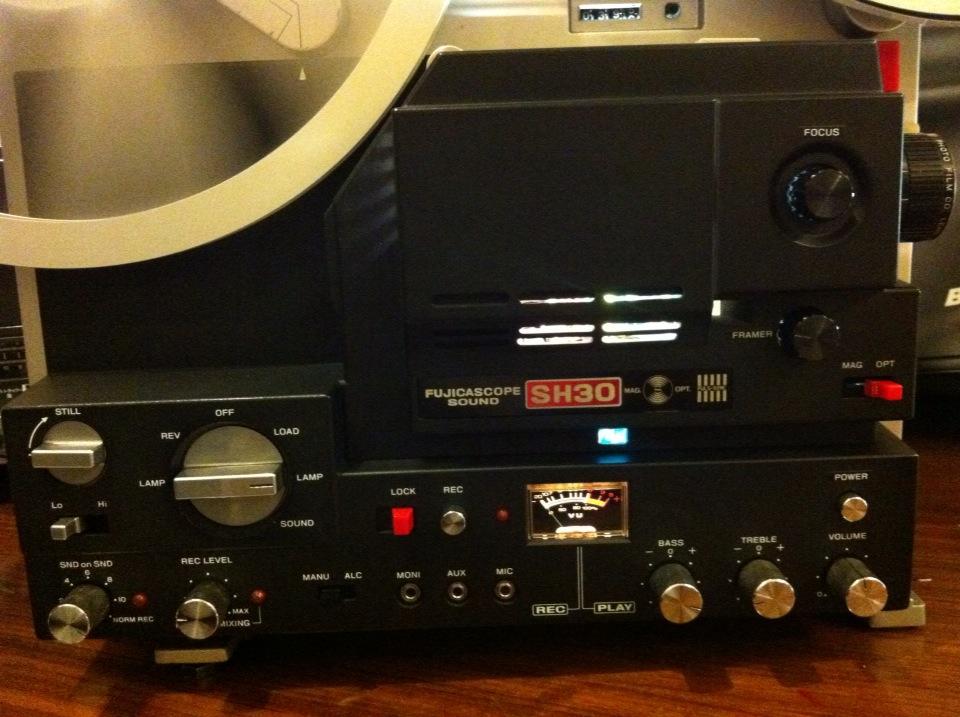
FUJICASCOPE SH30 and SD25. The Fujicascope SH30, introduced in 1975, was a projector ahead of its time, with a f1.0 14-28mm zoom lens, fine speed and a sophisticated electronic control (originally conceived to synchronize sound by electronic impulses or link two projectors for stereoscopy)

More complex electronically, and with stereo sound, is the Fujicascope SD25, with the same 1.0 lens and 360 meters reels capacity too, but a very useful speed control by quartz, microcomputer, and large digital frame reader. I use the Fujicascope SD25 to build the sound recordings in my movies. 

Fujicascope SH30

After the collapse of the Super-8 market, this model was sold at a fraction of its cost, in some markets,  as the Yelco 3600 (but with an inferior lens than the original Fujinon 1.0). Also interesting is its younger brother the Fujicascope SD20, with no microprocessor, but retaining the lens and quartz speed control. Quartz is essential when it comes to synchronizing with external devices such as a Blu Ray. In the Fujicascope SD25, being the filmmaker able to see the speed on the LED display, is possible to vary it at will when desired from 16 to 26 f.p.s. 

This 3 Fujicascope projectors use the 150 W lamp with good light output, because the fast pull-down of the claw. The excellent electronics giving good sound quality  with plenty of outlut power. 


The LED digital frame-counter is superb in the SD25, as also the microprocessor system for pre-programming. One strong point of this projectors are the magnetic head, of sendust type, able to last a lot of time! In facts, machines like this were used by Perry´s Movies, in London, to record the sound of commercial prints sold by this company. Further, this 3 Fujicascope sisters can play optical tracks, too.

A very clever design feature, on the Fujicascope SD25 Stereo Quartz (and SD20), for the independent filmmaker, is that all the sound inputs, which allow recording of complex tracks, are located on the front of the projector, and not on the back or the side.

Braun Visacustic 2000 with original Iscomorphot anamorphic

BRAUN VISACUSTIC 2000 DIGITAL. More than 40 years after its commercialization, the Braun Visacustic still attracts attention for its exterior design (which seduced Steve Jobs himself. He ordered two units of the 2000 Digital in Lee's Cameras, in 1983, which were personally delivered to him in his house in Belgravia by Martin Lee himself.  However, the best of Visacustic is inside:

1) Rear sprung pressure plate (in the lamp side), as in the Beaulieu (which allows project film with different thickness without the need to correct the focus) --more about this feature in installment 6 of this series--


2) Speeds of 16 2/3 and 25 f.p.s., in addition to the normal ones, as well as fine adjustment;

3) easy unthreading of a parcially projected film;

4) very fast pull down of the claw (for maximum light output of the 150 W lamp);
5) rounded edge projection frame;
6) swing open type lens holder; and
7) easy external electronic control, to enslave the machine with a Blu Ray reader or a quartz device.

The
 Braun Visacustic 2000 comes  with the famous Schneider f 1.1 11 - 30 mm. But few know that in the Braun company a female technique with eagle eyes (called Eva, perhaps?) tested the lenses individually, and the ones that did not meet the ideal characteristics were returned to the lens factory and perhaps sold to other makers: that's why all projections with a Visacustic 2000 look so sharp!


BEAULIEU STEREO STUDIO: A LIGHTHOUSE WITH A CHEAP LAMP.
The Beaulieu Stereo Studio halogen provides more light than the Elmo GS1200. How is it possible, if the Beaulieu use the inexpensive 150W lamp, instead of the expensive and hard to find 200W of the Elmo? One of the reasons is that the Beaulieu has a variable shutter, which allows the blades to be reduced from 3 to 2. 
But how does it get more light than the Fumeo 9119, which has a two-bladed shutter and the same expensive 200W ESC lamp of the Elmo GS1200?  

The explanation is its ultra-fast pull down in the Beaulieu, which allows each blade of the shutter to be reduced to just 40 degrees, instead of the Elmo's 60 degrees.
I love the Studio Stereo for syncing feature film audio in one go, from a digital source.


OTHER SPECIAL CHARACTERISTICS OF THE BEAULIEU STUDIO:
1) Rear sprung pressure in the side of the lamp: this allows to project films of different thicknesses without the need to correct the focus (for example, polyester with triacetate), with swing open type lens holder;
2) Micrometric focus: the most perfect ever made for Super-8, equaled only by the latest Fumeo series.
3) Variable shutter of 3 to 2 blades: this is important to achieve screens of six meters wide at 24 frames per second; also, to transfer to digital.
4) Fixed speeds but also variable speed: very important to transfer to digital.
5) Spectacular stereo-sound console with slider.
6) Able to accept 700 meters reels of triacetate (a complete feature film).   
Other interesting projectors from Beaulieu are the older models, as the standard EL Stereo (with mechanical VUmeters) and the Beaulieu Twin Track monophonic.


ELMO GS1200. The Japanese firm Elmo introduced its first GS1200 in 1978. Four series and several versions were made, such as PCom, HTI or xenon. The design concept was crazy and beautifully complicated: in place of one or two motors with several transmission systems, four motors! (in fact, is one of only two projectors with 4 motors)


The best of the Elmo GS1200 are the lenses. As standard, the f 1.1 12.5- 25mm is very good. But, pptionally, are available the non plus ultra of zoom lenses: f 1.0 12.5 - 30mm and the f 1.4 25-50mm long focal length lens (this long distance lens was improved to f 1.2 in later version, with an incredible optical quality, probably the best zoom ever made for Super-8. I have used the f 1.2 long distance zoom with the Elmo GS1200 in commercial theaters, over the years, with tip top results). 


The latest version of the GS1200, sold only in Germany, France and Spain, was the PCom, with a microprocessor with recording programs, a  noise reduction system, and a large LED frame counter. 

The Halogen Elmos GS1200 use the very special  and hard to find powerfull 24V 200W lamp code ESC (only produced in batchs). However, due to their slow pull down, with large blades in the shutter, Elmo GS1200 machines don't extract as much performance of the lamp as they could. 


The lens holder is of the swing open type: although without micrometrical focussing and with conventional pressure plate, is very easy to get focus even with th 1.0 lens.  Afer the gate, the Elmo GS1200 has a tendece  to be unkind with cement splices, in the lower loop and entry to sound section but this is not a trouble for me because I use always Fujifilm tape splices.

The comprehensive sound facilities, and the excellent arrangement of the two traks operation, in stereo, are a must for the filmmaker, with a logical and straighforward arrangement of the amplifier controls for the two channels. Magnetic head, as in the Fujicascope SD25 (and Goko editors) are "sendust", for very long life.  Of course, the Elmo GS1200 range has optical sound as standard (even, in Japan, was sold a version with only optical track reading!). 

Except for the first version of the GS1200, all the others support perfect sync with quartz devices currently built in Italy by Luigi Petrin and Renzo dal Bo

Elmo GS1200 are such an extraordinary projectors that one falls in love with them immediately. However, like beautiful lovers, apart from providing pleasure, it also generates a headaches; one problem with the Elmo GS1200 is that when they don't scratch the film in a place or other, then, they have an electronic or mechanical trouble: for this reason, the Elmo GS1200 are projectors that users like me love and hate at the same time!

Bauer T610. This is the top model of the Studio series of the German brand Bauer (models T502, T520, T525, T600 and T610), with stereo sound, a sophisticated electronic programming system and the Schneider f 1.1 11-30 mm as standard. The Studio class, very well made,  are the quietest projectors ever manufacturated.  


Its two drawbacks are the difficulty of unthreading the film in the middle of the projection and the plastic pressure gate. Neither, I don´t like the auto-thread mechanism, with automatically down the upper loop former, which is switched on every one that you try to stop the projection. But the pull-down claw mechanism is very well made and very kind with film.

Fumeo 9119. This is a 16 mm projector adapted in factory to project Super-8. The Fumeo 9119 was designed mainly as a projection-only machine (although it was sold as 9120 with recording option). This projector, very heavy,  transmit a solid engineering and feeling of quality. Picture on screen is so stable and so sharp thant the film grain can be clearly seen on screen, if the projector is with the optional Isco Cineluz f 1.1 11-30 mm lens.   The micrometrical focusing of later version is even better than the one of the Beaulieu, as the lens is placed in a lens holder and not fixed with a ring, so, the focus is held throught all the film. 

The sound quality is excellent and with a range of controls of frequency charasteristic much more comprehensive than are normally found in Super-8 projectors: there are three separate tone controls, provindig (each independently of others): 1) a bass rise or fall (giving un to more/minus  10dB at 10Hz. 2) A treble rise or fall (ut to more/minus 8db at 10 Kz). 3) A sharp rise in band of middle frequencies centred around 2Kz. Sound is very stable too, thanks to a fly wheel of more than 1 kg. of weight!  Projector can play also optical tracks. Standard 9119 was available with stereo magnetic heads as option.

Unlike the majority of lightweight 8 mm projectors, this Fumeo is of all-metal construction with minimal use of plastics. The main body, the back cover and the lampouse are all light-alloy die-castings, aa very strong and rigid assembly. 

Experienced projectionists will  be delighted to see this machine does not have automatic threading. It is assumed that the projector will be hadled ontly by a capable operator: threading and unthreading is manual. It is a machine designed for constant heavy use with regular mantenance (for example, as described in manual, oiling the felt pad on the claw cam after each 40 hours, and other adjustaments).  

The claw pull-down is not very fast, so, the blade sectors are of 60 degrees but the machine is with 2 blades instead 3 blades are usual in Super-8: so, a lot of light reach the screen from the 200W ESC (the very same that Elmo Gs1200), despite despite the fact that the lamp is at a further distance than the regulation. 

The drive motor is a large mains-voltage induction motor runing at constant speed: so, no brushes to clean in this kind of industrial motor. Projector has also provision for playing optical sound tracks. 


With regular lubrication, a Fumeo 9119 projector should out last our life. The provision  for really large reels of film, up to 800 meters. A very stron point is than spares for Fumeo 9119 are still available via Marco Sonetti in marks22son@gmail.com: Marco was a personal friend of Angelo Bianchi, the owner of Fumeo, and bought all the inventary of the beloved Italian factory. Stereo heads for Fumeo projectors are still made today!


What is my recommendation? If budget is a consideration and stereophony is not necessary, and you are looking for a reliable and easy to maintain projector, my recommendation is the Fujicascope SH30 (if you are looking for quartz precision as well, then the Fujicascope SD25 -or its Yelco 3600 clone, which, however, comes with a mediocre lens). 

If you value good design, in every way, and you have little space at home,  then you should to choose the Steve Jobs's projector: the Braun Visacustic 2000. Anyone looking for a quiet projector has any of the Bauer Studio range (Braun and Bauer are both for 240 meters reels only)

If in addition to being a filmmaker, you are a film-collector of feature films, then the Beulieu Studio. If you are only going to project movies, without recording sound, and you are looking for a projector that can last for eternity... and beyond, then, there is no other option than the Fumeo 9119. 

Elmo GS1200 is a magic projector but I do not recommend for isolated filmmakers because, for one reason or another, they are a source of problems: from scratches in the movies to failures in electronics or mechanics (I know, because I own the Elmo GS1200 IV, the PCom and the Xenon). All the faults in the Elmo GS1200 can be solved, but not everyone has access to a competent technician near home, like the Italian Luigi Petrin.

In this series of ten articles, a digest of the one published in the international magazine SilverGrain Classics, are described the most interesting projectors to buy, depending on the use they will be put to. 

Originally published in SilverGrain Classics


Which is the best zoom to buy? Article about high quality zooms in European size.


COVID CHRISTMAS , the shooting.

This rainy and sad Christmas season, when I left work daily, around six in the afternoon, on the days that it was not raining, I was shooting different parts of my city, with hand-held camera, with a colour film that some say is very bad , the reversible AGFA Aviphot in polyester.

In my opinion, there is no bad film, but all color rendering and grain has its use for a certain purpose of the story to shoot. For "COVID Christmas" I chose the sad colors, and the coarse grain, of the Aviphot, to reflect the saddest Christmas I can remember, without joy, with merchants and shops almost in bankrupt and many people with diminished income. 

Film will be processed by Riccardo Pascucci in Rome. Camera was my beloved Fujica ZC1000 mostly with the small Fujinon 5.5 mm EBC wideangle lens, but with some takes with the standard 7.5-75 mm lens.

In the series of short films called "COVID", each type of film stock, as usual in my filmography, is part of the language. The intimacy of family life, with strongly outdated Kodak Vision-2 500, in "COVID-19 Phase O" (during lockdown, the family life and values like solidarity were reinforced, with homemade faceshields to give away for free in ambulatory health centers. While the hypochondriac freelancer drives to work, he hears the coronavirus symptoms in the radio... that make him feel sick!)

COVID-19 PHASE 0 from IB CINEMA Motion Picture Films on Vimeo.

The vivifying colours of Kodak Vision 50, for "COVID-19 Phase III", shot in June 2020 when we already believed that the nightmare was over and life returned to normal. How wrong we were!

COVID-19 PHASE III from IB CINEMA Motion Picture Films on Vimeo.

lunes, 4 de enero de 2021

EL CINE EN SÚPER-8 DE JORGE SUÁREZ-QUIÑONES

Aunque arquitecto de formación, Jorge Suárez-Quiñones tiene su corazón volcado en el cine, el cine en Súper-8. Le disgusta que sus creaciones se vean digitalizadas y pugna, ante los organizadores de los festivales, que se proyecten con película. Lo ha conseguido, hace unos días, en el Documenta de Madrid con su obra "Meihödö", una película que hace comprender al espectador un mundo que parecía desaparecido pero que aun sobrevive, pero para hacerlo tuvo que llevar su propio proyector de xenón, el buscadísimo Elmo GS1200 Xenón, que él, además, posee con el objetivo 1.2 especial para larga distancia que es el objetivo más nítido jamás diseñado para el Super-8, rozando los límites físicos del sistema. 

El extraordinario GS Xenon de Jorge con la gloriosa óptica 1.2

En IB Cinema, también poseemos uno de estos raros proyectores de xenón, que usamos profesionalmente desde hace años cuando de lo que se trata es proyectar Súper-8 en gran pantalla, sin necesidad de recurrir a proyectores tan descomunales como el Fumeo 9145 cuyo rectificador sólo pesa mas de 35 kilos. El GSXenon de Jorge, sin embargo, está en estado cosmético impecable, no como el de IB Cinema que se encuentra un poco trasteado, como consecuencia de largos y exitosos años de trabajo.

Lo bueno del Elmo GS1200 Xenon es que se puede transportar tranquilamente por una persona. Con nuestro Elmo GS1200 Xenón hicimos, hace un par de años la proyecciones conmemorativas del 90 cumpleaños de Mickey Mouse en varios cines de Galicia.